Creative Minds 𖹭 Happy Hearts

Light Intensity on Photosynthesis Rate Lab Sheet
Counting bubbles is the whole experiment. Your student uses an aquatic plant, a lamp, and a ruler to measure how light intensity on photosynthesis rate actually changes with distance.
Your student moves a lamp closer and farther from an aquatic plant, counting oxygen bubbles released per minute at each distance. The data table on this light intensity on photosynthesis rate lab sheet records test number, lamp distance in centimeters, light intensity level, bubble count, and temperature notes across four trials. It is well matched to grades 5-8 and introduces controlled variables in a hands-on, observable way.
The sheet fits naturally into a unit study on plant biology, cellular processes, or energy in living systems. It works as a standalone investigation or as a follow-up after your homeschooler has studied the basic chemistry of photosynthesis. By the time your student writes the conclusion, they have practiced forming a hypothesis, collecting quantitative data, identifying patterns, and connecting evidence to an explanatory answer.
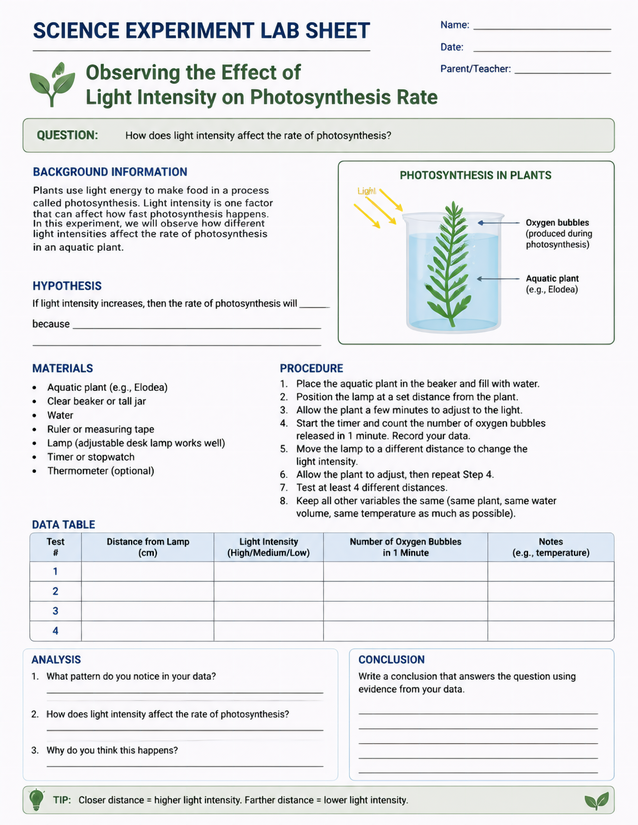
Count oxygen bubbles to measure the light intensity on photosynthesis rate in aquatic plants. Ideal for grades 5-8 homeschoolers.
Investigating Light Intensity on Photosynthesis Rate with Elodea

Usage Notes
Most materials are household items: a clear beaker or tall jar, water, a ruler, and a timer. The one specialty item worth sourcing ahead of time is an aquatic plant such as Elodea, available at most pet or aquarium stores inexpensively. No open flames or hazardous chemicals are involved, though the sheet notes keeping water temperature consistent across trials, so a thermometer is a useful addition.
Printing Tips
A standard sheet of copy paper works fine for writing during the experiment, but 24 lb paper holds up better if the workspace is near water. Slip the printed sheet into a clipboard so your student can record bubble counts in real time without the paper shifting.