Creative Minds 𖹭 Happy Hearts

Pollution Effect on Plant Growth Lab Sheet, 14-Day Experiment
Three pots, two pollutants, fourteen days of data: the pollution effect on plant growth has rarely been this concrete for a homeschool science table.
Your student begins by forming a hypothesis about how pollution changes plant development, then sets up three small pots side by side: one watered with clean water as the control, one with a soapy or detergent solution, and one with salty water. Height measurements and appearance notes are recorded on days 0, 3, 7, 10, and 14 in a structured data table, giving your homeschooler a clear numerical picture of how each treatment diverges over time. The pollution effect on plant growth lab sheet is well matched to grades 4 through 7 and works naturally as a standalone unit or as the hands-on anchor for a broader environmental science study.
Once the two-week observation window closes, four analysis questions push your student to compare results, name the best and worst performers, and articulate what the pollutants actually did to each plant’s appearance and height. A conclusion section asks them to synthesize those findings into a complete written statement, so the sheet moves beyond recording numbers and into genuine scientific reasoning. Pair it with reading on water quality or soil contamination for a cohesive unit study, or run it as a single experiment that introduces controlled variables for the first time.
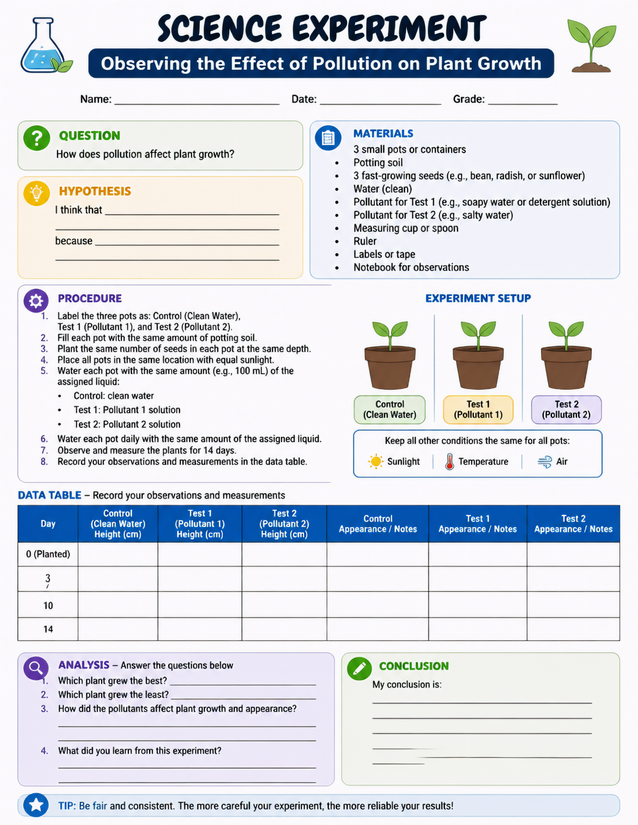
Grades 4-7 homeschoolers track the pollution effect on plant growth across three pots over fourteen days. All materials are household items.
Investigating the Pollution Effect on Plant Growth in Three Pots

Usage Notes
Every material on the list is a household item: small pots or containers, potting soil, fast-growing seeds such as bean or radish, clean water, soapy water, salty water, a measuring cup, a ruler, and labels. No specialty supplies are needed, though gloves are worth putting on a nearby hook if younger students will handle the detergent solution each day. The 14-day watering schedule is light on prep time but requires daily consistency, so build a simple reminder into your lesson planner.

Printing Tips
Card stock at 65 lb holds up well here since students return to the data table daily for two weeks and repeated writing on thin paper tends to buckle. Slip the sheet into a plastic page protector inside a science lab notebook so it stays flat and protected between observation sessions.