Creative Minds 𖹭 Happy Hearts

Salt Affects Ice Melting Rate Lab Sheet, Homeschool Experiment
Two ice cubes, one teaspoon of salt, and a timer are all your student needs to watch freezing point depression happen in real time. This salt affects ice melting rate lab sheet guides the whole investigation from hypothesis to conclusion.
Your student places one ice cube in each shallow dish, adds a teaspoon of table salt to only the right-hand dish, then records observations every minute until both cubes fully melt. The data table tracks time in minutes from zero through six-plus, asking students to note what they see in each dish and circle which cube has less ice at every interval. Designed for grades 3-6, this salt affects ice melting rate worksheet gives young homeschoolers a hands-on look at how dissolved solutes change the physical behavior of water.
The experiment works as a standalone lesson on states of matter or slots naturally into a unit study on chemistry, winter weather science, or physical changes. Because students collect timed data and then write three conclusion responses plus a bonus ‘Think More’ prompt about increasing salt concentration, the sheet demonstrates observation skills, controlled variable thinking, and basic scientific writing all in one session. Add it to your homeschool curriculum the day you introduce freezing point depression or road safety chemistry.
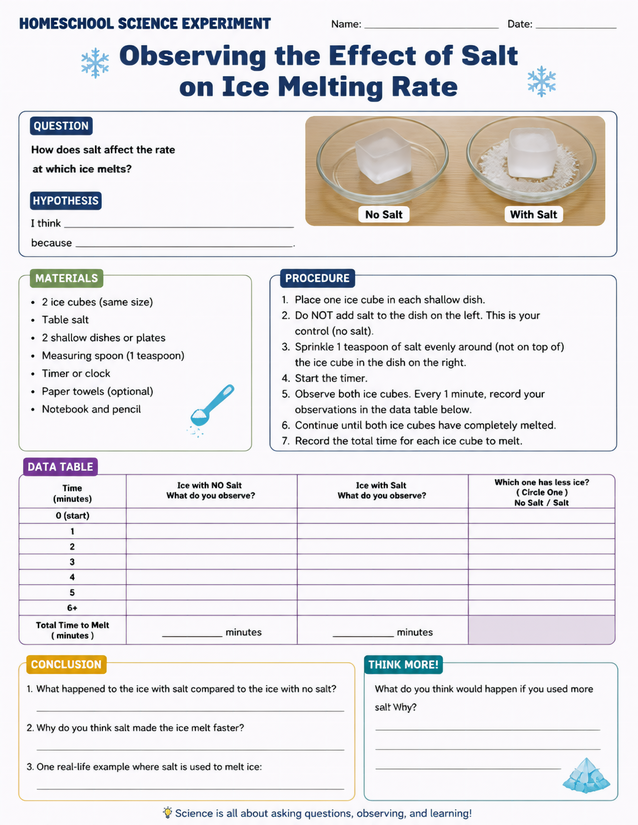
Does salt affects ice melting rate faster? Grades 3-6 homeschoolers record minute-by-minute observations in this ready-to-print experiment sheet.
Investigating Salt Affects Ice Melting Rate Step by Step

Usage Notes
Everything on the materials list is a standard kitchen item: two same-size ice cubes, table salt, two shallow dishes or plates, a teaspoon measure, and a timer. No specialty supplies are required, and the only safety consideration is keeping the work surface dry to prevent slipping. Paper towels listed as optional on the sheet make cleanup straightforward.

Printing Tips
Twenty-pound copy paper handles pencil observations at each minute interval without trouble, but 24-pound paper stays flatter if the sheet gets damp near the dishes. Slip it into a plastic page protector before the experiment starts and wipe down between uses, or punch and insert a fresh copy into your student’s science lab notebook as a permanent record.