Creative Minds 𖹭 Happy Hearts

Food Coloring Movement in Heated versus Cooled Water Lab Sheet
Drop one bead of food coloring into hot water and one into cold, and the difference is immediate. Recording food coloring movement in heated water versus cooled water makes diffusion and particle energy visible in under a minute.
Your student drops a single bead of food coloring into a glass of hot water and another into cold, then records what they see at 0, 15, 30, 45, and 60 seconds in a structured observation table. The sheet walks grades 3 to 6 through a written hypothesis, a timed procedure, and four analysis questions that push beyond simple observation to ask why the food coloring movement in heated water behaves differently and what that reveals about particle energy and temperature.
The experiment stands alone as a one-session introduction to diffusion, but it also fits naturally into a unit study on states of matter or molecular motion. By completing the hypothesis, the timed observation table, and the analysis section, your homeschooler demonstrates the ability to form a testable prediction, collect time-stamped evidence, and connect observable results to an underlying scientific principle.
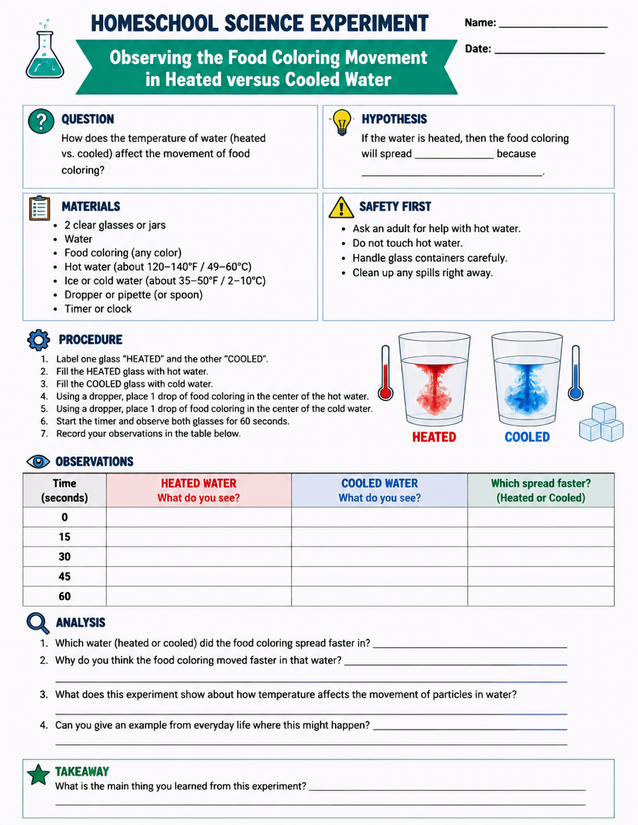
Watch food coloring movement in heated water spread faster than in cold water. Grades 3-6 homeschool experiment, instant download.
Recording Food Coloring Movement in Heated Water Step by Step

Usage Notes
Every material on the sheet is a household item: two clear glasses or jars, water, food coloring in any color, a dropper or spoon, and a timer. Hot water requires adult supervision, and the sheet’s Safety First section explicitly reminds students to ask for help, avoid touching hot containers, and clean up spills immediately.

Printing Tips
Card stock is unnecessary here. Standard 20 lb copy paper holds up fine for pencil and pen entries during the experiment. Slip the sheet into a plastic page protector if you want students to write on the observation table with a dry-erase marker for repeated use, or print one copy per run and keep finished sheets in a lab notebook.