Creative Minds 𖹭 Happy Hearts

Dew on Different Surfaces Lab Sheet, Observations and Conclusions
Put metal, fabric, wood, and stone side by side over a bowl of ice and the dew on different surfaces lab sheet records exactly what forms where, and why some materials collect far more than others.
Your student begins by forming a hypothesis about whether texture or material type controls how much dew collects, then stretches plastic wrap over a bowl or tray, places four to six household surfaces on top, and slides ice cubes underneath to cool the air. After 30 to 60 minutes they observe each surface for water droplets and record the texture, whether dew formed at all, the quantity, and the droplet size in a six-column table. A science connection box explains condensation in plain terms, and four conclusion questions ask students to compare results and identify patterns. This dew on different surfaces lab sheet suits grades 3 through 6 and works naturally within a weather, water cycle, or states of matter unit study.
Used standalone, the sheet still tells a complete story because the procedure walks through every setup step and the conclusion section asks students to reason from their own data rather than recall memorized facts. Paired with a water cycle or weather unit, it gives your homeschooler a hands-on data collection experience that connects the abstract idea of condensation to something they can watch happen on a kitchen counter. Completing the sheet demonstrates observation skills, basic data recording, and introductory scientific reasoning.
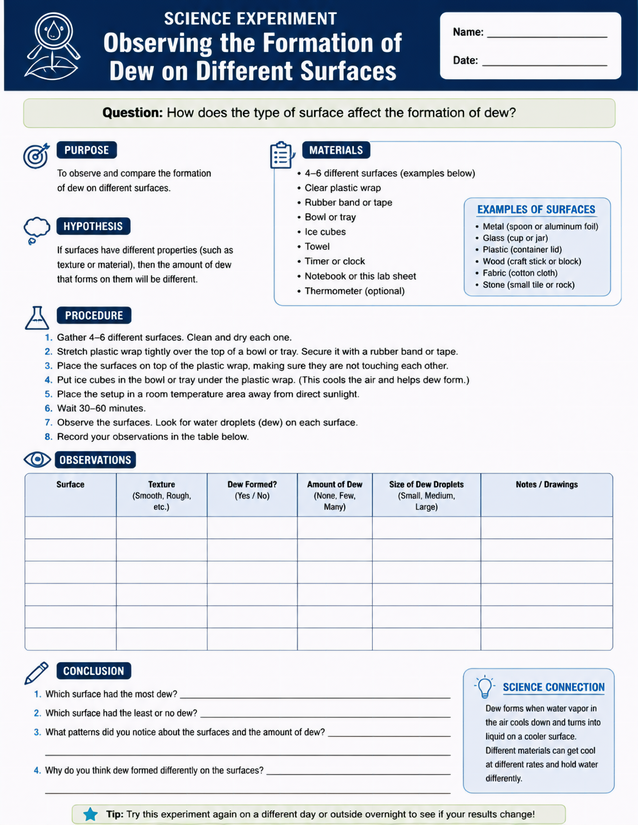
Six surface materials, one cold tray, and your dew on different surfaces lab sheet reveal how texture and material affect condensation. Grades 3-6.
Getting Started with Your Dew on Different Surfaces Lab Sheet

Usage Notes
Nearly every material listed is already in your kitchen or recycling bin. Metal foil, a glass jar, a plastic container lid, a scrap of fabric, a small tile or craft stick, and a bowl with ice cubes cover the full surface set. No specialty supplies are needed, and there are no chemical or heat hazards involved, making this a low-supervision setup for most grade levels.
Printing Tips
Standard 20 lb copy paper works here since students fill in the observation table after returning from the experiment rather than writing on a wet surface. Slide the sheet into a clipboard if your student prefers to record notes tableside, or punch and insert it directly into a science lab notebook when the experiment is complete.