Creative Minds 𖹭 Happy Hearts

Observing the Formation of Stalactites with Epsom Salt Solution
Saltwater drips. Crystals form. Your student records every change across fourteen days with this formation of stalactites lab sheet that makes cave geology happen on your kitchen counter.
Geology comes alive when your homeschooler dissolves Epsom salt in warm water, suspends a string inside a clear jar, and then simply waits. This formation of stalactites lab sheet walks students through the scientific method from writing a hypothesis to sketching daily observations in a structured table that tracks changes on Days 1, 3, 5, 7, 10, and 14. It suits grades 4 to 7 and connects Earth science vocabulary like evaporation and mineral deposition to something students can watch develop in real time.
The sheet fits naturally into a geology or Earth science unit study, and it works beautifully as a standalone long-form observation project. By the time your student fills in the conclusion and Extend Your Learning prompts, they have demonstrated how to track a slow physical process, connect a kitchen experiment to natural cave formation, and ask follow-up questions like what humidity does to the rate of crystal growth.
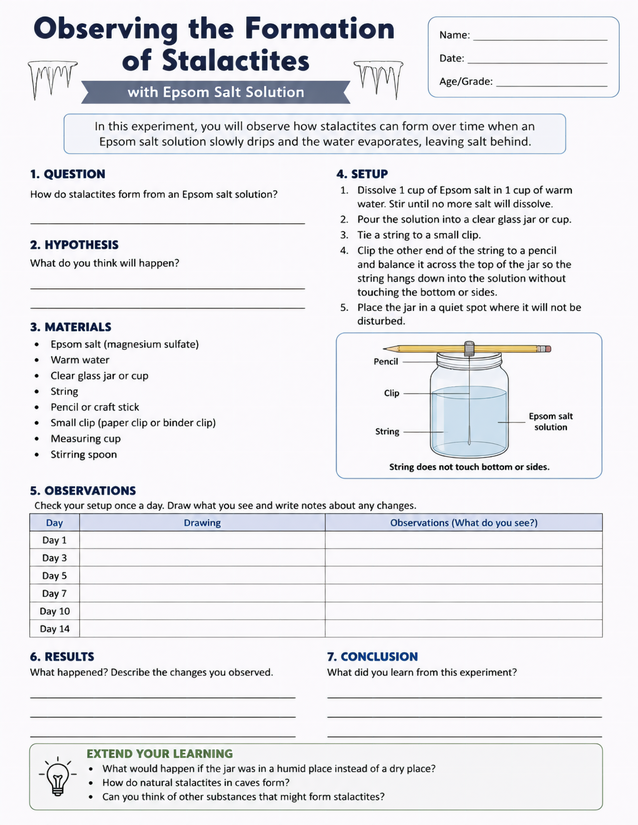
Record crystal growth day by day with this formation of stalactites lab sheet, designed for grades 4 to 7 homeschoolers. All household materials.
Getting Started with the Formation of Stalactites Lab Sheet

Usage Notes
Every item on the materials list is a standard household supply: Epsom salt, warm water, a clear glass jar or cup, string, a pencil or craft stick, a small clip, a measuring cup, and a stirring spoon. No specialty science supplies are needed. The setup diagram on the sheet clearly shows that the string must hang without touching the bottom or sides of the jar, so review that detail with your student before they begin.

Printing Tips
Standard 20 lb copy paper works fine here since students write in the observation table once a day rather than during a wet or messy procedure. Slip the sheet into a plastic page protector inside a lab notebook to keep it flat over the full fourteen-day run, or clip a loose sheet to a clipboard near wherever the jar is sitting undisturbed.