Creative Minds 𖹭 Happy Hearts

Bacteria Growth Near Antibiotic Discs Lab Sheet, Zone of Inhibition
Four labeled discs, one petri dish, and a clear ring of nothing where the bacteria could not survive. This bacteria growth near antibiotic discs lab sheet turns that invisible fight into measurable, recordable science.
Your student observes a prepared agar plate without opening it, identifies antibiotic discs by their labels A through D, and measures the diameter of each zone of inhibition in millimeters using a ruler. The observation and measurements table on this bacteria growth near antibiotic discs lab sheet records both diameter and clarity notes for each disc, and a sketch box lets your student draw the actual plate rather than copy a generic diagram. Five analysis questions push past data collection and ask which antibiotic worked hardest, why zone size varies, and what the experiment’s limitations are. This is solid grades 6-9 microbiology work.
The sheet fits naturally into a unit study on microbiology, disease, or the history of antibiotics, and it stands alone just as well as a single-session lab tied to a co-op science day. By completing it, your homeschooler demonstrates the ability to measure, compare, and draw conclusions from a controlled variable, and the final analysis question on experimental limitations introduces the critical thinking vocabulary your student will need in upper-level science coursework.
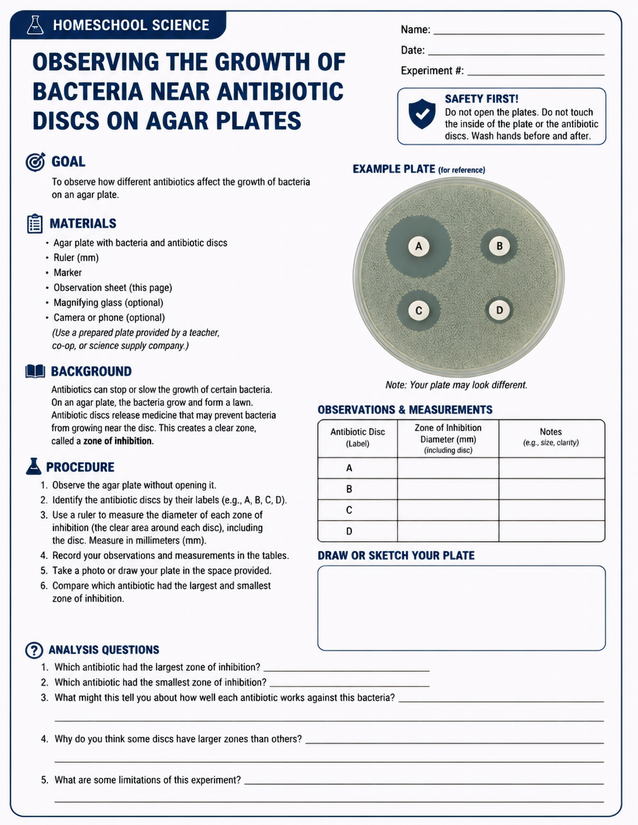
Four antibiotic discs, one agar plate: this bacteria growth near antibiotic discs lab sheet suits grades 6-9 homeschoolers measuring zones of inhibition.
Investigating Bacteria Growth Near Antibiotic Discs Step by Step

Usage Notes
The prepared agar plate with antibiotic discs is a specialty supply sourced from a teacher co-op or science supply company, as the sheet itself notes. Household items handle the rest: a ruler marked in millimeters, a marker, and an optional magnifying glass or camera. The safety box is prominent and specific, reminding students not to open the plate and to wash hands before and after, so review those instructions with your student before the lab begins.
Printing Tips
Standard 20 lb copy paper works for the measurements table and analysis questions, but 24 lb paper holds up better if your student is writing while the sheet sits on a clipboard next to the plate. Slip the completed sheet into a dedicated lab notebook section so zone-of-inhibition data stays paired with any unit notes on antibiotics or bacterial resistance.