Creative Minds 𖹭 Happy Hearts

Yeast Growth Under Different Sugar Concentrations Lab Sheet
Five cups, five sugar levels, one question: does more sugar always mean more yeast? Your student records foam height every ten minutes to find out with this yeast growth under different sugar concentrations lab sheet.
Active dry yeast, warm water, and granulated sugar are all your student needs to run a controlled experiment comparing 0%, 1%, 2%, 4%, and 8% sugar solutions. The sheet walks through labeling cups, dissolving sugar, adding yeast, and then recording foam height in millimeters at ten-minute intervals for a full sixty minutes. Designed for grades 5-8, this homeschool worksheet builds vocabulary around independent variables, dependent variables, and controlled conditions right on the page.
The yeast growth under different sugar concentrations experiment fits naturally into a unit study on cellular respiration, microorganisms, or fermentation. Your student completes the observation grid, identifies which concentration produced the tallest foam column, and then answers four analysis questions that push past data collection into explanation. Finishing the sheet demonstrates the ability to connect a quantitative result to a biological mechanism, a skill that bridges life science into chemistry at the middle school level.
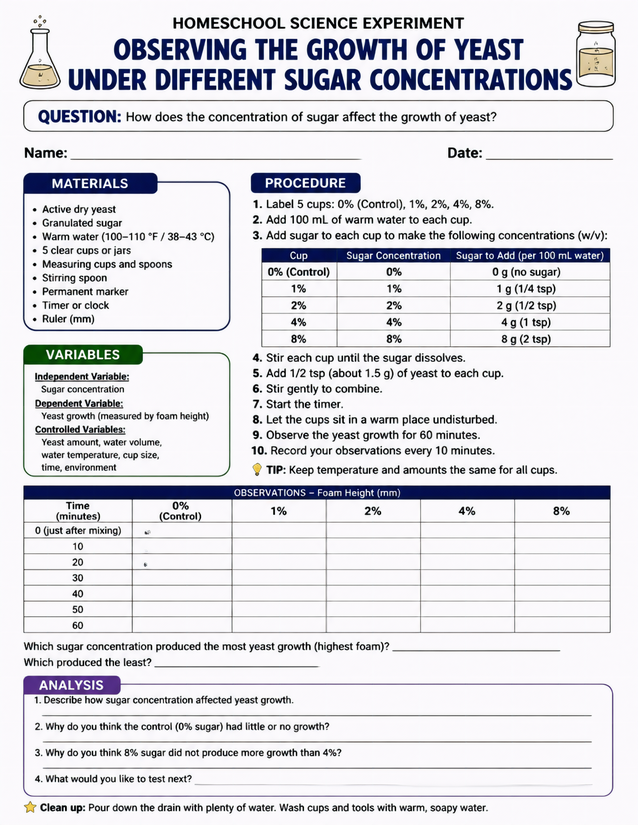
Measure yeast growth under different sugar concentrations across five cups in this hands-on homeschool science lab for grades 5-8.
Recording Results for Yeast Growth Under Different Sugar Concentrations

Usage Notes
Active dry yeast, granulated sugar, warm water kept between 100 and 110 degrees Fahrenheit, five clear cups or jars, measuring spoons, a ruler marked in millimeters, a stirring spoon, a permanent marker, and a timer are all you need. Every item is a household staple, so no specialty supplies are required. No heat sources or chemicals beyond food-grade ingredients are involved, making this a low-risk experiment your student can run largely independently.

Printing Tips
Standard 20 lb copy paper works for a loose sheet on a clipboard placed beside the cups during observation. If you want the sheet to survive any drips, slip it inside a clear page protector and have your student record lightly in pencil first, then transfer to a clean printed copy for the lab notebook afterward.