Creative Minds 𖹭 Happy Hearts

Mealworm Life Cycle Lab Sheet, Egg to Darkling Beetle
Four stages, one living habitat, and weeks of real observations your student will record themselves. This mealworm life cycle lab sheet turns a container of larvae into a complete biology unit.
Darkling beetles complete one of the most observable insect life cycles available to homeschool families, and this mealworm life cycle lab sheet walks grades 3-5 students through all four stages from egg to adult. The sheet opens with a labeled circular diagram showing egg, larva (mealworm), pupa, and adult beetle, each with a brief caption. Students record a hypothesis, then log observations at least two to three times per week in a table that prompts them to note date, behavior, size, color, changes, current stage, and a hand-drawn sketch.
As a standalone unit study or a companion to an invertebrate or insect metamorphosis sequence, this lab sheet builds real scientific habits over several weeks of continuous observation. Analysis questions ask your student to identify which stage appeared most, describe changes noticed across the cycle, name the most interesting finding, and compare the mealworm life cycle to other insects. A care and safety section at the bottom reminds students to handle mealworms gently, keep the habitat dry, and wash hands before and after contact, making it practical for independent student use.
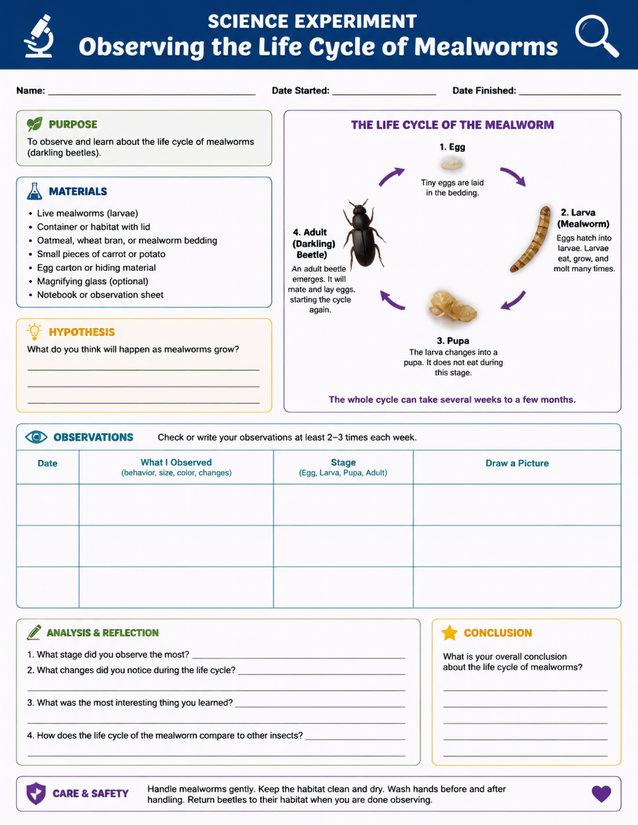
A mealworm life cycle lab sheet for grades 3-5 homeschoolers tracking egg, larva, pupa, and adult darkling beetle stages firsthand.
Investigating with a Mealworm Life Cycle Lab Sheet Over Several Weeks

Usage Notes
Live mealworms are the only specialty supply here. Everything else on the materials list, oatmeal or wheat bran for bedding, small carrot or potato pieces for moisture, an egg carton for hiding, and a container with a lid, is either already in the kitchen or inexpensive at a hardware store. A magnifying glass is listed as optional but worth having for the larva and pupa stages. No heat source or chemicals are involved, though the safety section reminds students to wash hands after handling and to return adult beetles to their habitat.

Printing Tips
Card stock at 65 lb holds up well when students write across multiple sessions without the sheet buckling on a clipboard. Hole-punch the finished sheet and slip it into a science binder alongside any sketches made outside the table, or keep it loose so students can lay it flat next to the habitat while observing.