Creative Minds 𖹭 Happy Hearts

Magnetic Polarity of Different Bar Magnets Lab Sheet
Compass in hand, your student marks north and south poles across three different bar magnets, then tests whether like poles truly push each other away. That is the magnetic polarity of different bar magnets in action, recorded right here.
This lab walks grades 4 to 6 students through a focused investigation of magnetic polarity. Using a small compass, your student identifies the north and south pole of each bar magnet by watching which end the red compass needle points toward, labels both ends, then brings magnet pairs together to observe and record attraction and repulsion. The observations table on the sheet has columns for left-end and right-end pole identification plus three interaction columns per magnet, so results stay organized across all three trials. Four analysis questions push beyond data collection, asking your student to explain what happens when like poles meet versus unlike poles, and how a compass can reveal an unknown magnet’s polarity.
The magnetic polarity of different bar magnets concept sits naturally inside a unit study on magnetism, electricity, or force and motion for upper elementary. It works as a standalone one-session experiment or as an early lab in a longer magnetism sequence before introducing electromagnets. A Think Further prompt at the bottom asks whether all bar magnets share the same strength, opening a door to a follow-up paper-clip test that your homeschooler can design independently.
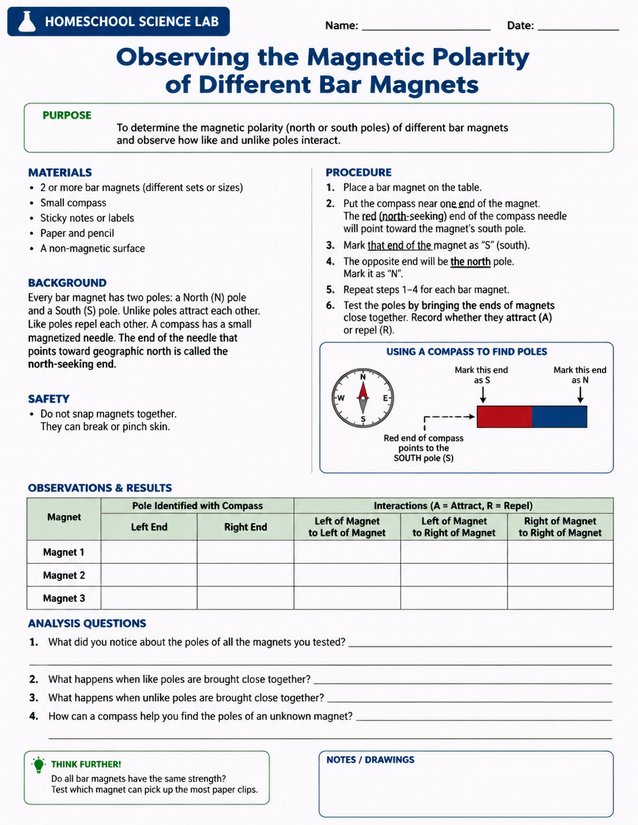
Grades 4-6 homeschoolers use a compass to identify the magnetic polarity of different bar magnets and record attract-or-repel interactions.
Recording Results for Magnetic Polarity of Different Bar Magnets

Usage Notes
Two or more bar magnets from different sets or sizes are the core supply, and the sheet specifically notes they should vary so comparisons are meaningful. A small compass, sticky notes or labels, paper, a pencil, and a non-magnetic surface are all household-level items. One safety note is printed directly on the sheet: do not snap magnets together, as they can break or pinch skin, so keep that in mind if your student is younger.

Printing Tips
Standard 20 lb copy paper is fine here since pencil entries fill the table, but 24 lb paper will hold up better if the sheet gets slid across a non-magnetic work surface repeatedly during the magnet tests. Slip it inside a plastic sheet protector in a lab notebook after the experiment is done to keep the recorded data alongside any follow-up notes your student adds.