Creative Minds 𖹭 Happy Hearts

Bird Migration Patterns Lab Sheet, Multi-Week Field Observation
Binoculars, a field guide, and a yard or park are all your student needs to start this bird migration patterns lab sheet that spans the full migration season.
Designed for grades 4-7, this bird migration patterns lab sheet guides your homeschooler through multi-week field observation of local species during spring and fall migration. Your student records date, time, weather conditions, species name, number of birds, direction of travel (N, S, E, W), and behavior notes such as flying, resting, or feeding, all in a structured data table that makes pattern recognition straightforward at the end of the study period. The guiding question asks which species migrate through your area, when they arrive and depart, and what direction they travel, pushing students to think like naturalists rather than passive observers.
This bird migration patterns lab sheet works well as a standalone unit or as the field component of a broader ecology or life science sequence. It fits naturally into a Charlotte Mason nature study approach or a traditional science curriculum that needs a real-world data collection element. Students demonstrate scientific inquiry by forming a hypothesis, observing systematically over several weeks, recording quantitative and qualitative data, and drawing evidence-based conclusions. Extension ideas on the sheet, including cross-referencing eBird data and graphing weekly species counts, extend the learning further without requiring additional materials.
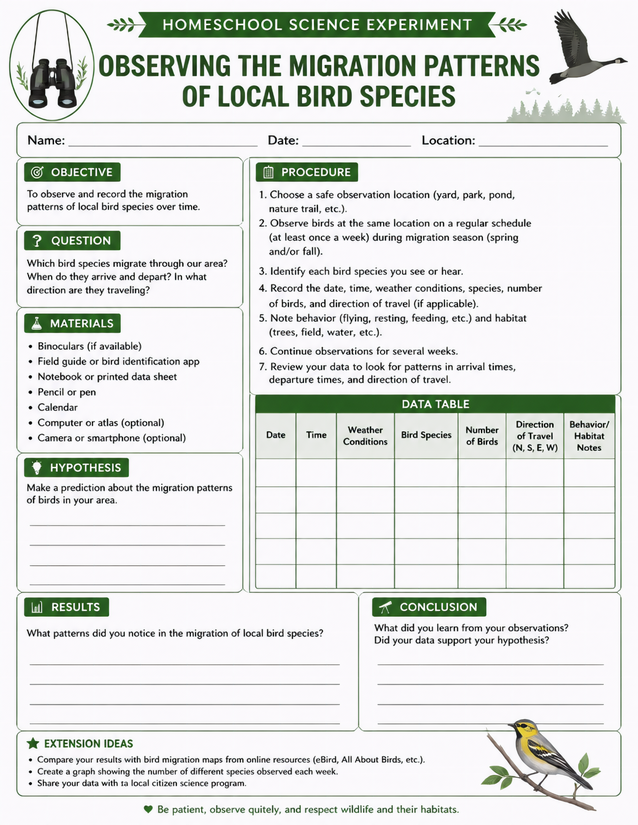
A bird migration patterns lab sheet built for grades 4-7 homeschoolers tracking local species across spring and fall migration season. Print and observe.
Investigating with a Bird Migration Patterns Lab Sheet Over Multiple Weeks

Usage Notes
Binoculars are listed as optional, and most observations work fine without them. A field guide or bird identification app, a pencil, a calendar, and access to an outdoor location are the core requirements, all household or freely available items. No safety concerns apply beyond the sheet’s own reminder to observe quietly and respect wildlife and their habitats.

Printing Tips
Standard 20 lb copy paper works fine for this sheet, but 24 lb paper holds up better on a clipboard during outdoor sessions where the page may get damp or bent. A loose sheet on a clipboard is the natural fit here since observations happen away from a desk, though the completed sheet tucks neatly into a science binder or lab notebook once the season wraps up.