Creative Minds 𖹭 Happy Hearts

Tectonic Plates with Clay Layers Lab Sheet, Grades 4-6
Stack four colors of clay and suddenly plate tectonics makes sense. This tectonic plates with clay layers experiment lets your student push, pull, and slide their way to understanding mountains, valleys, and faults.
Modeling the tectonic plates with clay layers experiment, this lab sheet guides grades 4 to 6 students through three distinct types of plate movement: convergent (plates moving toward each other), divergent (plates moving apart), and transform (plates sliding past each other). Students stack four to six colors of clay into a shallow tray, mark the top layer with a ruler or toothpick to track deformation, then use an index card to simulate each movement type. After each test, they record what happened to the layers, name the landform created, and sketch what they observed in a structured table. A conclusion prompt asks students to summarize what they learned about plate movement, and a Think Further section connects clay results to real Earth features like earthquakes, volcanoes, and ocean trenches.
This lab fits naturally into an Earth science unit study on geological processes or a Charlotte Mason-style nature of the Earth sequence. It stands alone as a single session or pairs well with a rock cycle lesson or a topographic map activity. By completing it, your student demonstrates an understanding of how surface landforms originate from forces deep within the Earth, a core concept in most grades 4 to 6 science curricula.
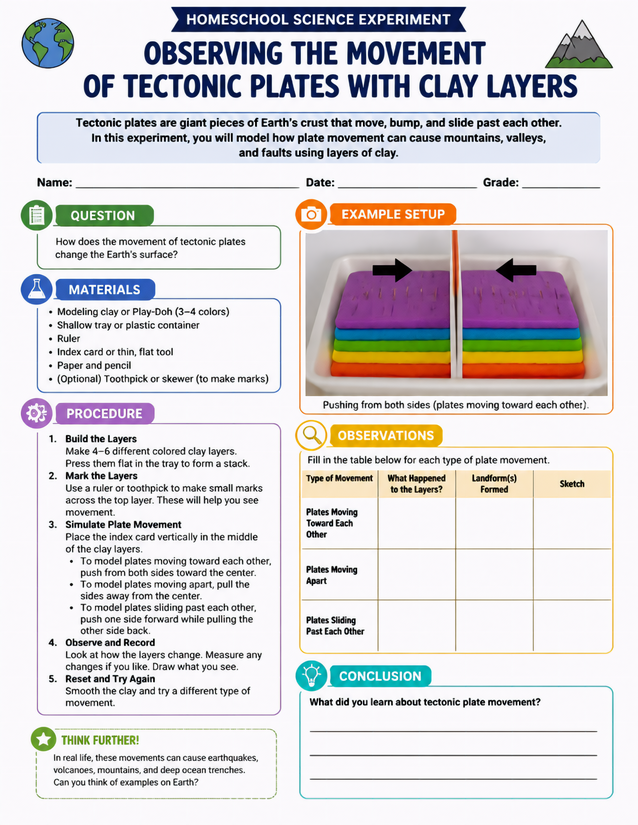
Colorful clay stacks make the tectonic plates with clay layers experiment tangible for grades 4-6 homeschoolers. Instant download.
Investigating with a Tectonic Plates with Clay Layers Lab Sheet

Usage Notes
Modeling clay or Play-Doh in three to four colors is the main supply, and the sheet specifies a shallow tray or plastic container to contain the stack. Everything else, including a ruler, index card, paper, and pencil, is a standard household item. No heat or chemicals are involved, though younger students may need a reminder to keep clay out of carpet during the reset-and-try-again step.

Printing Tips
A standard 20 lb copy paper sheet works fine here since students record observations after the hands-on portion rather than writing mid-experiment. Punch and insert it into a science lab notebook, or keep it as a loose sheet on a clipboard beside the clay tray so it stays clean during the messy parts.