Creative Minds 𖹭 Happy Hearts

Observing the Phases of the Moon Lab Sheet, 30-Night Tracking
Thirty nights, one moon, and a pencil is all your student needs. Observing the phases of the moon becomes a real scientific habit with this structured lab sheet that walks from the new moon to the next full cycle.
Observing the phases of the moon over a full month, this lab sheet guides grades 3-6 students through a nightly outdoor observation routine. Each of the 30 rows in the tracking table asks your student to draw the moon’s shape in a small circle, shade the lit portion, record the phase name using the eight-phase reference guide printed on the left side of the sheet, and add any notes on brightness or position. A background section explains that moonlight is reflected sunlight and that the visible shape changes as the moon orbits Earth. The big question printed in the upper right corner, asking how the moon’s shape appears to change over time, frames the whole month as a single sustained inquiry.
This lab sheet fits naturally into an astronomy unit study or an Earth science sequence for your homeschooler. It works as a standalone month-long investigation or as the observational anchor alongside reading on lunar cycles and tides. Three reflection questions at the bottom ask your student to identify the pattern they noticed, calculate how many days elapsed between full moons, and summarize what they learned, demonstrating both observational skill and the ability to draw conclusions from their own recorded data. Observing the phases of the moon in this format builds the habit of returning to the same question night after night, which is foundational scientific practice.
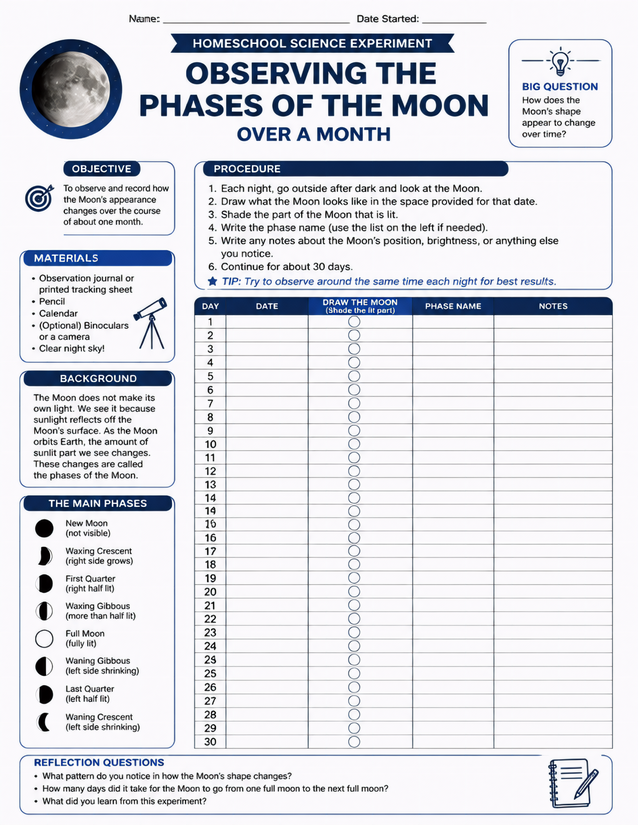
Grades 3-6 homeschoolers spend a month observing the phases of the moon with this detailed tracking and reflection sheet. Instant download.
Getting Started with Observing the Phases of the Moon Over 30 Nights

Usage Notes
Nearly everything on the materials list is already in your home. Your student needs a pencil, a calendar, and access to a clear night sky. Optional binoculars or a camera are listed for enhanced observation but are not required. No safety concerns are involved beyond standard after-dark outdoor supervision.
Printing Tips
A standard 20 lb copy paper works fine, but 24 lb paper holds up better when your student writes in the narrow table rows each night. Slip the sheet into a clipboard for nightly outdoor use, or punch and add it to a dedicated science lab notebook so the 30-day sequence stays intact.