Creative Minds 𖹭 Happy Hearts

Observing the Properties of Ferrofluids with Iron Filings and Oil
Iron filings suspended in oil form dramatic magnetic spikes, and this properties of ferrofluids lab sheet walks your student through making and observing that reaction from start to finish.
Your student mixes one teaspoon of iron filings with two to three teaspoons of light oil in a small clear jar, then moves a neodymium magnet around the outside, underneath, and above the jar while recording how the fluid responds. The sheet asks them to note what shapes form, whether the fluid returns to normal when the magnet is removed, and how the response changes with different magnet positions. Suited for grades 5-8, it pairs well with a unit on magnetism, fluid dynamics, or materials science.
The properties of ferrofluids lab sheet works as a standalone session or as part of a broader electromagnetism unit. By completing the observations and conclusion sections, your homeschooler demonstrates that magnetism can act on a liquid through a physical barrier and that magnetic force varies with proximity and angle. It is a strong entry point for discussing real-world applications like hard drive seals and speakers.
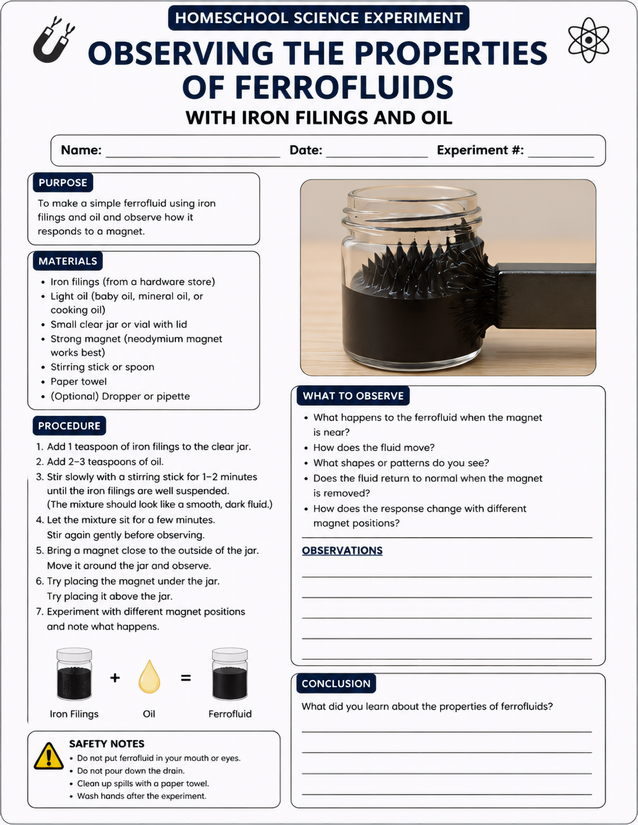
Mix iron filings and oil to create a properties of ferrofluids lab sheet experiment suited for grades 5-8 homeschoolers. Instant download.
Investigating with a Properties of Ferrofluids Lab Sheet

Usage Notes
Iron filings are the one specialty item here, typically sourced from a hardware store or science supply vendor. Everything else, light oil, a small jar with a lid, a stirring stick, and paper towels, is a household staple. The safety notes printed on the sheet are worth reading aloud before you begin: ferrofluid should not contact eyes or go down the drain, and hands need a thorough wash afterward.
Printing Tips
Standard 20 lb copy paper works, but 24 lb paper holds up better if the jar drips during the experiment. A loose sheet on a clipboard keeps it flat and easy to write on while your student moves the magnet around the jar.