Creative Minds 𖹭 Happy Hearts

Light Refraction with Water and Glass Homeschool Lab Sheet
A pencil in a glass of water that looks broken is the first clue your student records on this light refraction with water and glass lab sheet.
Your student begins by filling a clear glass three-quarters full of water, placing a pencil or straw inside, and stepping back to observe how it appears to bend at the waterline. From there, the experiment shifts to shining a flashlight beam at the water surface and recording how the light changes direction, then repeating the process with a glass block or empty cup to test refraction through glass. Two separate observation rows ask your student to document what they saw and how the light changed direction in each medium, making this light refraction with water and glass lab sheet a strong fit for grades 4 through 6 studying physical science or light properties.
The sheet walks through the full scientific method, from writing a hypothesis to sketching diagram observations in two labeled boxes and answering four analysis questions that push past simple recall. Question four asks students to name two real-life examples of refraction, which makes a good discussion prompt for your end-of-lesson debrief. Add this to a unit study on waves and optics, or use it as a standalone hands-on learning session before introducing lenses or the electromagnetic spectrum.
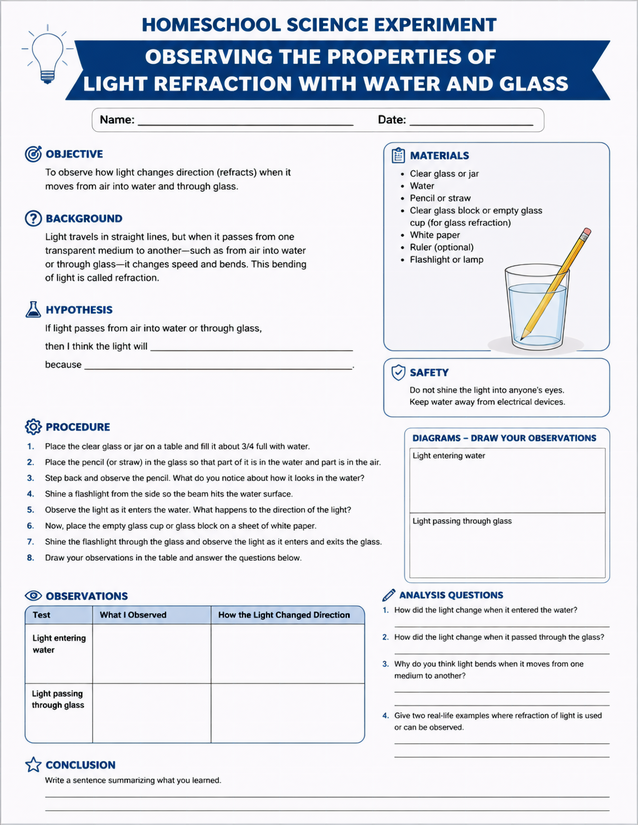
Grades 4-6 homeschoolers explore light refraction with water and glass using household materials and a structured recording sheet.
Setting Up Light Refraction with Water and Glass at Home

Usage Notes
Every material on this sheet is a household item: a clear glass or jar, water, a pencil or straw, a flashlight or lamp, white paper, and optionally a ruler. A clear glass block or second empty cup is listed for the glass refraction portion, which most families can substitute with any thick-walled glass. The safety note on the sheet flags two points: avoid shining the flashlight directly into eyes, and keep water away from any electrical devices used during the lamp step.
Printing Tips
Standard 20 lb copy paper handles pencil writing well for this lab, but 24 lb paper holds up better if the sheet gets damp near the water activity. Print as a loose sheet to clip to a board at the edge of the table, keeping the recording area away from the glass of water.