Creative Minds 𖹭 Happy Hearts

Ordering Numbers Least to Greatest, 3rd Grade Worksheet
Six problem sets, two-digit numbers through four-digit numbers, all asking your student to sequence from smallest to largest. Ordering numbers least to greatest gets genuinely interesting once commas appear in the mix.
Six problems take your student from manageable two-digit sets all the way up to four-digit numbers with commas, covering a solid range of number sizes in one sitting. The layout is clean: a row of five numbers at the top, five blank answer lines below, and a reminder at the bottom about what to do when two numbers are equal. This ordering numbers least to greatest worksheet is labeled 3rd grade and fits naturally into a number sense unit at that level.
Add it to your homeschool curriculum during a unit on place value or number sequencing and it works well as independent practice once your student understands how to compare digits by place. Problem five includes a repeated number (18 appears twice), which gives your homeschooler a small but important decision point about equal values. Completing the sheet builds the habit of scanning all numbers before committing to an order, a skill that carries directly into multi-step math.
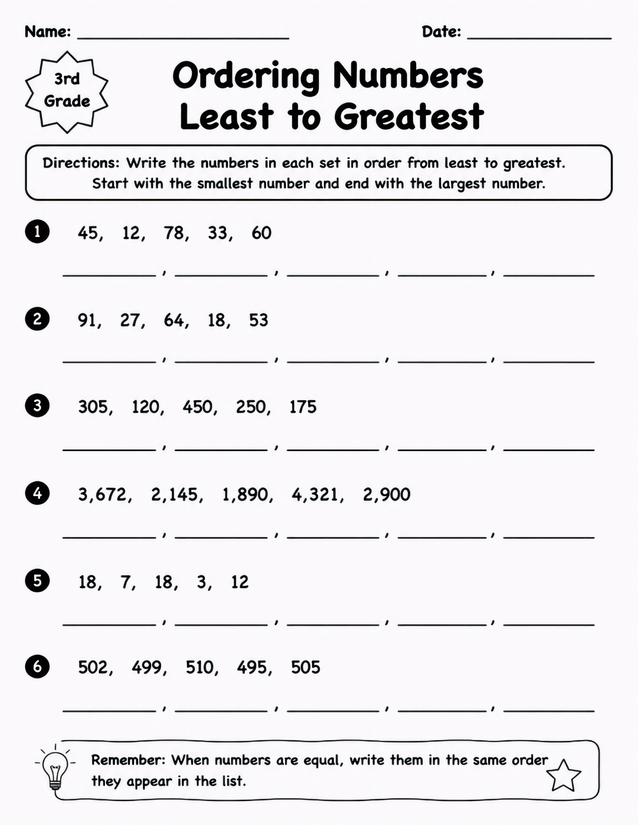
Six sets of ordering numbers least to greatest problems build number sequencing skills for 3rd grade homeschoolers. Includes two-digit through four-digit numbers.
Practicing Ordering Numbers Least to Greatest Across Six Problem Sets

Usage Notes
Pencil is the practical choice here since students often need to cross-check and revise their sequence before writing final answers on the blanks. The answer lines are sized for written numerals, so this works well as independent practice for a 3rd grader who has already been introduced to place value comparisons. If your student is newer to four-digit numbers, work through problems four and six together before letting them finish solo.

Printing Tips
Portrait orientation is already set, so send it straight to the printer. Twenty-four pound paper gives the answer lines a slightly firmer feel for writing, though standard copy paper handles it fine if you are printing a week’s worth at once.