Creative Minds 𖹭 Happy Hearts

Patterns With Even and Odd Numbers Worksheet, Four Activities
Classifying, extending, evaluating, and creating: patterns with even and odd numbers shows up in all four forms on this one sheet.
Four numbered sections move your student from recognition to creation. Section one asks them to label ten numbers, including 14, 27, 91, and 100, as even or odd. Section two presents four number sequences, two even and two odd starting from different points, and asks for the next three terms each time. Section three offers five true-or-false statements about digit endings and specific numbers. Section four flips it around, asking students to write their own even pattern and their own odd pattern from scratch. A reference box at the top defines both categories and lists examples, so this sheet works as a standalone introduction for grades 2 to 3.
For your homeschooler, this fits naturally into a unit on number sense or as a warm-up during a week focused on skip counting. The patterns with even and odd numbers format here builds three distinct skills in one sitting: identification, sequence logic, and generalization from rules. Section three works well read aloud together, while sections one, two, and four are solid independent practice once your student has reviewed the reference box.
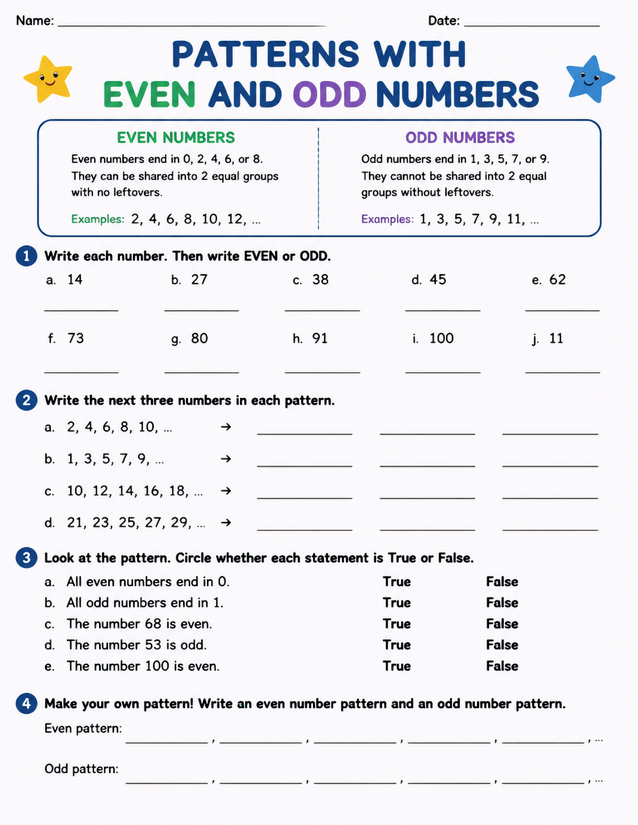
Grades 2-3 homeschool math: patterns with even and odd numbers across four structured activities. Ready to print now.
Building Skills with Patterns With Even and Odd Numbers

Usage Notes
A standard pencil handles every section here since students write short labels, single numbers, and circled true-or-false responses. The create-your-own section at the bottom benefits from guided instruction the first time through, but sections one and two are straightforward enough for independent work after a quick look at the reference box.

Printing Tips
Portrait orientation is already set. Standard 20-pound copy paper is fine since students are writing numbers and circling responses rather than coloring. Printing two copies gives one for practice and one to file in a math binder.