Creative Minds 𖹭 Happy Hearts

Two-Step Multiplication Word Problems, Four Real-World Scenarios
Four scenarios, two steps each, one clear habit built: your student learns to slow down, break the problem apart, and show every move before writing a final answer. That is what two-step multiplication word problems train.
Each of the four problems on this sheet asks your student to multiply across two separate steps before landing on a final answer. The scenarios cover rows of desks holding stacks of books, boxes of markers broken into packs, zoo penguins divided across exhibits, and a bakery running production over several days. Every problem box provides a labeled Step 1 line, a Step 2 line, and a ruled answer blank, so your homeschooler always knows exactly where to record each piece of thinking. This layout suits grades 3 through 5, particularly students who have learned single-operation multiplication and are ready to chain two facts together.
Add this sheet to a unit study on multiplication or use it mid-week as a standalone skills check. The two-step multiplication word problems format asks students to identify what gets multiplied first, compute that product, then apply it to the next operation rather than reaching straight for an answer. That sequencing habit is one of the harder shifts in upper elementary math, and structured practice like this, with explicit step lines, builds it steadily over repeated use.
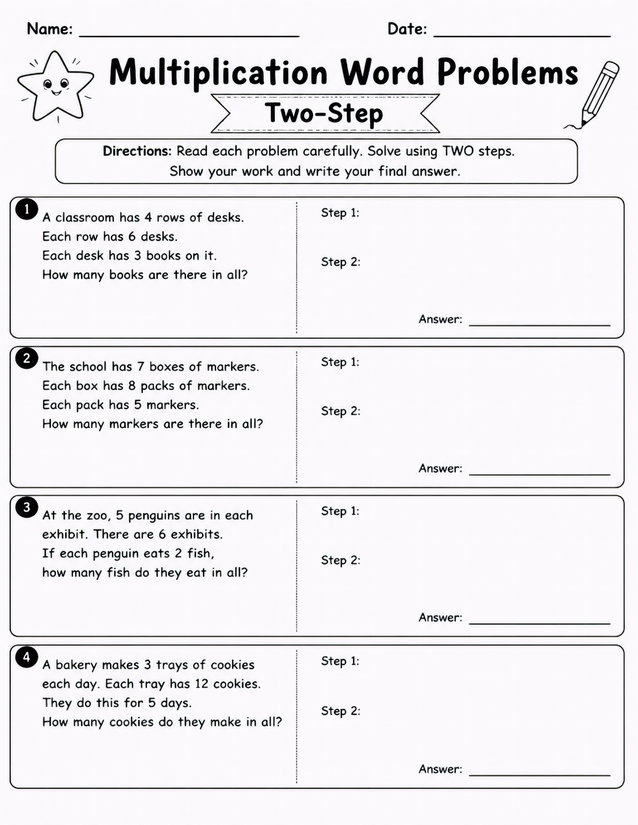
Grades 3 to 5 homeschoolers practice two-step multiplication word problems across four real-world scenarios with structured show-your-work boxes.
Building Problem-Solving Skills with Two-Step Multiplication Word Problems

Usage Notes
A pencil is the right tool here because your student will likely revise their Step 1 work before reaching Step 2. The structured boxes make this suitable for independent practice once your homeschooler understands how to isolate a first operation. For students newer to multi-step reasoning, a single guided read-through of problem one before releasing them to work on their own goes a long way.

Printing Tips
Portrait orientation is already set, so standard copy paper works without adjustment. Printing two or three copies at once gives you built-in retake sheets without extra trips to the printer.