Creative Minds 𖹭 Happy Hearts

Milliliters and Liters Worksheet, Conversions to Word Problems
Milk cartons, water bottles, juice boxes, and buckets all on one page. This milliliters and liters worksheet builds real-world capacity sense through conversions, comparisons, and multi-step word problems.
Structured across four numbered sections, this milliliters and liters worksheet covers every angle of capacity measurement your student needs at the grades 3 to 5 level. Section one asks students to convert between mL and L, section two uses inequality symbols to compare capacity values, section three presents four written word problems with work space included, and section four is a matching activity pairing illustrated containers like a milk carton and a bucket to the amounts they realistically hold. A reference box at the top supplies the key conversion facts and fractional equivalents, so students can focus on applying the relationships rather than memorizing them from scratch.
This sheet works well as a standalone lesson day or dropped into a measurement unit study after your student has had a basic introduction to liters. The word problems in section three require students to add, subtract, and convert within context, making them a step up from drill-only practice. Independent use is possible for confident students who can read problem text on their own, though the word problems in section three benefit from a quick read-through together before your student works solo.
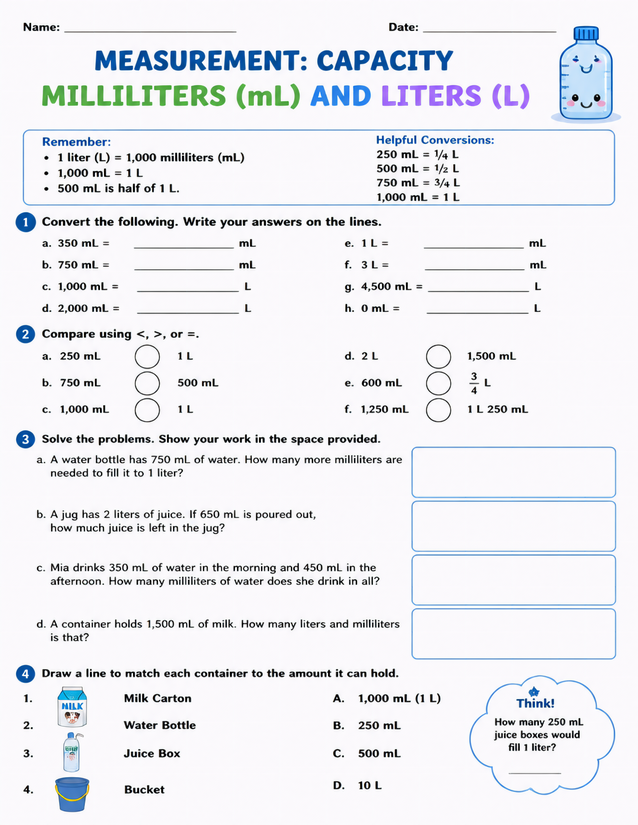
Convert, compare, and solve capacity problems with this milliliters and liters worksheet designed for grades 3 to 5 homeschoolers.
Working Through a Milliliters and Liters Worksheet on Capacity

Usage Notes
Pencil works best here since the comparison and conversion sections involve fill-in answers that students may want to revise. The word problem boxes have enough room for written work but not elaborate diagrams. Students in grades 4 and 5 should be able to complete this independently once the reference box is reviewed together.
Printing Tips
Standard copy paper handles all the writing comfortably in portrait orientation. Printing two or three copies lets your student revisit the word problems on different days without running out of clean workspace.