Creative Minds 𖹭 Happy Hearts

Temperature Conversion Worksheet, Celsius and Fahrenheit for Grade 3
Celsius to Fahrenheit in two steps, Fahrenheit to Celsius in two more. This temperature conversion worksheet hands your student the shortcut rules and then asks them to use those rules right away.
This temperature conversion worksheet is labeled 3rd Grade Math and walks students through both conversion directions in a single page. The introduction defines temperature and names both scales, a highlighted rule box shows the multiply-by-2-then-add-30 method for Celsius to Fahrenheit and the subtract-30-then-divide-by-2 method for Fahrenheit to Celsius, and two fully worked examples model each process before any practice begins. Four conversion problems follow in boxed answer spaces, covering 15°C, 25°C, 68°F, and 104°F, plus a fifth word problem asking students to convert an 18°C weather forecast into Fahrenheit.
For homeschool parents teaching math at the 3rd grade level, this temperature conversion worksheet fits naturally inside a measurement unit or alongside a science weather study. The rule-then-example structure makes it manageable for independent work once you have walked through one example together, and completing all five problems gives your student repeated practice applying two-step arithmetic in a real-world context.
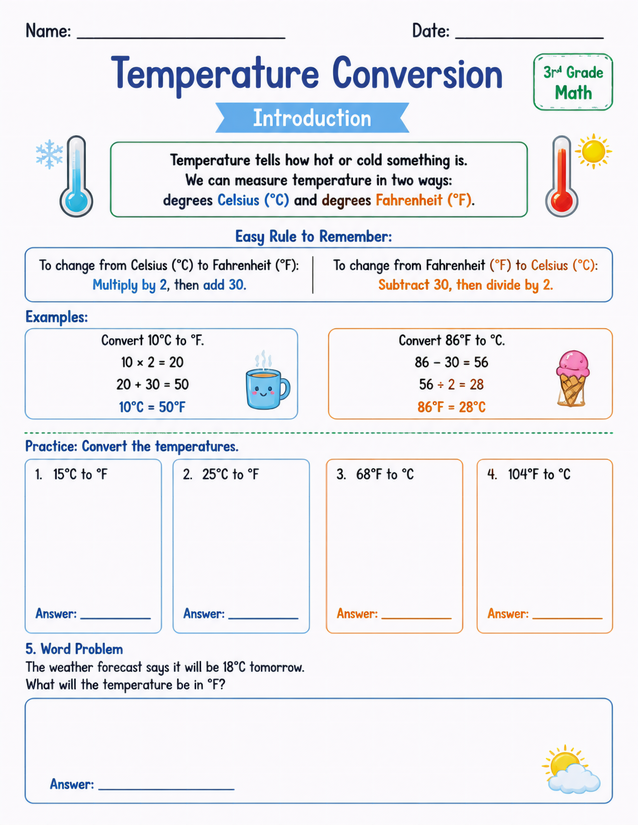
Introduce Celsius and Fahrenheit conversions with this temperature conversion worksheet, designed for 3rd grade homeschool math.
Practicing with a Temperature Conversion Worksheet in Grade 3

Usage Notes
A pencil works best here so your student can show their two-step work inside each answer box and erase if they make an arithmetic slip. The four practice problems and word problem are well suited to independent work after a brief guided walkthrough of the example section together.

Printing Tips
Standard 20 lb copy paper is fine for pencil work. Portrait orientation matches the layout, and printing two copies lets your student attempt the problems a second time later in the week as a quick review.