Creative Minds 𖹭 Happy Hearts

Complete Sentences vs Fragments Worksheet, 10 Practice Items
Subject and predicate together, or just a dangling phrase? This complete sentences vs fragments worksheet gives students ten real examples to sort out, with definitions and examples right on the page.
A cheerful smiling star and pencil frame the title at the top, setting a friendly tone before students reach the work. The definition box uses color-coded text, blue for complete sentence and green for fragment, so the two concepts stay visually distinct throughout the activity.
The ten numbered items mix genuine complete sentences with plausible-sounding fragments like ‘After school yesterday’ and ‘In the blue house on the corner,’ which are exactly the tricky cases students need to practice spotting. A tip box at the bottom reinforces the core rule without giving away answers. Complexity is low to moderate, making this a comfortable independent activity rather than a frustrating one.
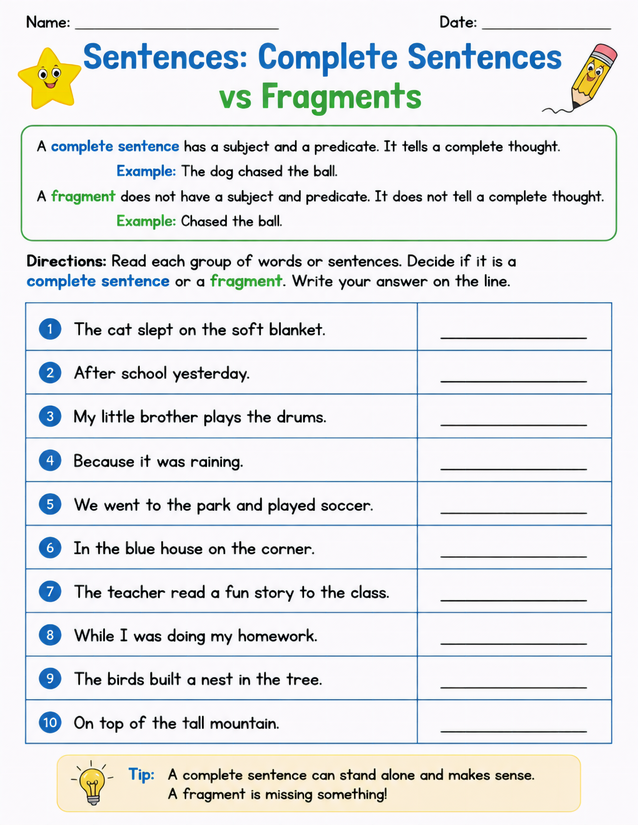
Identify complete sentences and fragments with this complete sentences vs fragments worksheet featuring ten practice items and a helpful tip box.
How to Approach the Complete Sentences vs Fragments Worksheet

Usage Notes
Colored pencils work well here if a student wants to circle or underline before writing the answer, since the lines are light enough not to compete. A fine liner in blue or green can highlight the definition box terms to match the color coding already printed on the page. Avoid broad-tip markers on the answer lines, as bleed-through can obscure the ruled guides.
Printing Tips
Standard copy paper handles this cleanly, but bumping the scale to 105 percent on a borderless setting prevents the outer table borders from clipping at the page edge.