Creative Minds 𖹭 Happy Hearts

Fruit and Vegetable Shape Recognition Worksheet, Four Shapes
Apples in two shapes, a carrot hiding inside a triangle, and a banana that fits perfectly inside a rectangle. This fruit and vegetable shape recognition worksheet makes four basic shapes feel genuinely logical.
Four quadrants fill the page, one for each shape: circle, square, triangle, and rectangle. Each quadrant pairs a kawaii fruit or vegetable drawn inside the outlined shape with a small “Examples” row below it showing three familiar real-world objects in that same shape. The circle quadrant features a red apple inside a green circle, with an orange, a watermelon slice, and a tomato as examples. The square quadrant shows a green square apple inside a blue border, with a cheese slice, a cracker, and a gift box below. The triangle quadrant places a kawaii carrot inside a purple triangle, with a pizza slice, a watermelon wedge, and a tortilla chip as examples. The rectangle quadrant holds a smiling banana inside an orange border, with a door, a chocolate bar, and a brick wall beneath it.
Part of the Homeschool collection, this fruit and vegetable shape recognition worksheet works well read aloud using the instruction banner at the top: “Look at the shapes. Say the names.” Children point to the main character, name the shape, then scan the examples row to reinforce that the shape appears in ordinary objects. The layout suits one-on-one sessions or small group work where an adult can prompt the naming exercise without any writing required.
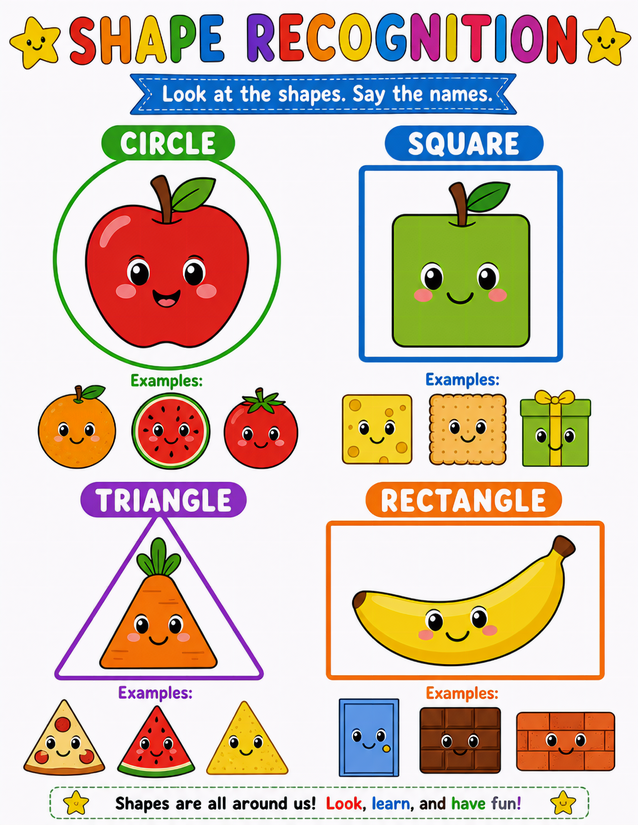
Kawaii apples, a carrot, and a banana teach four shapes on this fruit and vegetable shape recognition worksheet. Free instant download.
Getting Started With Your Fruit and Vegetable Shape Recognition Worksheet

Usage Notes
No writing fields appear on this page, so standard printer ink is all that is needed. If you want to turn it into a reusable oral activity, lamination works well and a dry-erase marker lets a child circle or point to named shapes repeatedly. The example rows are compact, roughly thumbnail-sized, so fine liners hold up better than chunky markers if you ever want to annotate or label the examples.
Printing Tips
A single-sided print on 90 gsm or heavier paper keeps the bright colours from looking washed out and gives the page enough body to survive repeated handling by small hands. Print a copy per child for take-home reference, or print one laminated class copy for a shared pointing activity.