Creative Minds 𖹭 Happy Hearts

Robot Tall or Short Worksheet, Six Illustrated Pairs
Two cartoon robots hold up the rules, and then six pairs of illustrated objects put those rules to the test. Your robot tall or short worksheet comes loaded with rulers, clear prompts, and a cheerful “Great job comparing!” at the finish.
A bold “Tall vs Short” header sits at the top, flanked by a blue robot and a red robot each holding a definition sign. A dashed reference box in the center shows the greater-than and less-than symbols labeled “taller than” and “shorter than.” Below that, a two-line instruction tells learners to circle the taller object and cross out the shorter one. Six color-bordered cards are arranged in a two-row grid. Each card shows a pair of illustrated objects set against a numbered ruler scale running from zero to ten, with a dashed vertical divider separating the two items and an empty circle beneath each one for the child’s response. The pairs visible are a tall building beside a small house, a giraffe beside a zebra, a leafy tree beside a flowering bush, a large pencil beside a smaller pencil, a tall stack of books beside a shorter stack, and a triple-scoop ice cream cone beside a single-scoop cone.
This robot tall or short worksheet suits early learners working on measurement vocabulary and visual comparison skills, and it fits naturally into the Homeschool collection alongside other math concept pages. The circle-and-cross-out format keeps the task unambiguous for young children who are not yet writing full answers, and the numbered ruler beside each object gently introduces the idea that height can be measured, not just eyeballed. One sheet covers six comparisons, making it a solid standalone activity or a quick warm-up before a measuring lesson.
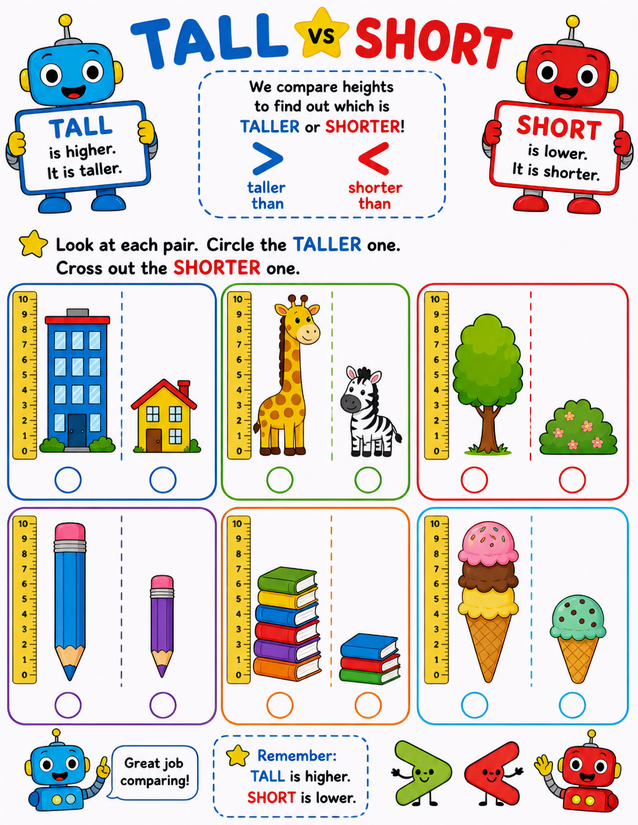
Friendly robots introduce taller and shorter with this robot tall or short worksheet. Six illustrated pairs, instant download.
Getting Started With Your Robot Tall or Short Worksheet

Usage Notes
A standard pencil is the natural fit here since children need to circle one object and cross out the other, and pencil marks are easy to correct if they second-guess themselves. The response circles beneath each card are roomy enough for a thick crayon mark if a younger learner prefers that. Ink from markers or gel pens will bleed through standard 20 lb paper, so stick to pencil or crayon unless you are printing on cardstock.
Printing Tips
Laminate a copy and swap pencil for a dry-erase marker to reuse the sheet across multiple sessions without reprinting. If you are running a group lesson, printing a small batch at 100 percent scale on letter-size paper keeps the ruler markings legible and the card borders crisp.