Creative Minds 𖹭 Happy Hearts

Addition and Subtraction Word Problems Mixed, Six Real-World Scenarios
Six story problems, one sheet, and your student has to decide whether to add or subtract before they even write a number sentence. That decision-making step is exactly what addition and subtraction word problems mixed practice is built for.
Each of the six problems on this sheet presents a real-world scenario with numbers reaching into the hundreds, and students must read carefully, write a number sentence, and show their work in the open space below each prompt. Problems include a librarian adding books to a shelf, a baker counting remaining cookies, students across two grade levels, apples in a basket, pages read across two days, and birds leaving a park. The layout targets grades 2 through 4, where choosing the correct operation is as important a skill as computing the answer.
Adding this sheet to your homeschool math rotation gives your student practice distinguishing between joining and separating situations, a foundational step in moving from basic fact fluency to applied problem-solving. Because no scaffolding hints at which operation to use, your homeschooler works through the reading comprehension layer of math alongside the arithmetic. It suits independent work once your student is comfortable with three-digit addition and subtraction, or as a guided lesson where you talk through the problem structure together before they write anything down.
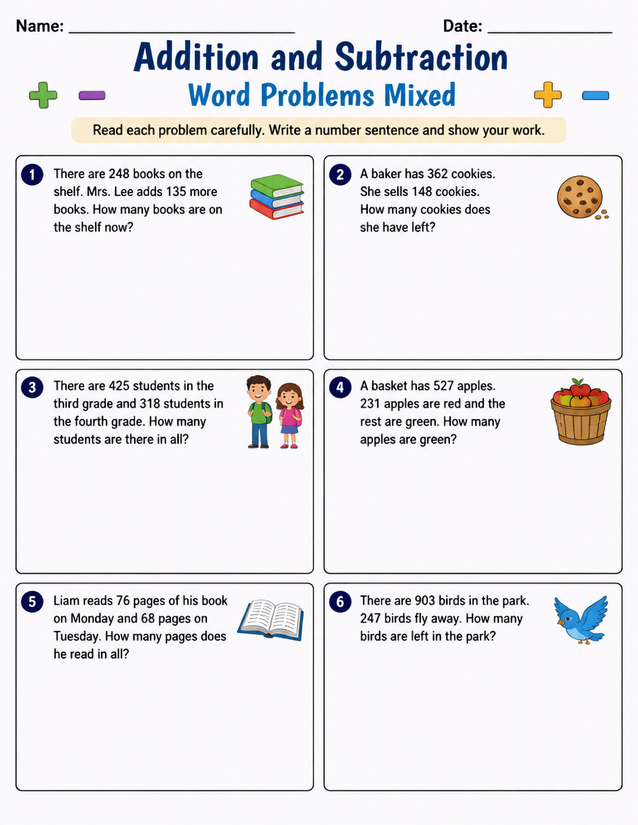
Six story problems covering addition and subtraction word problems mixed with three-digit numbers, suited for grades 2 through 4 homeschoolers.
Building Judgment with Addition and Subtraction Word Problems Mixed

Usage Notes
Pencil is the right tool here since students are expected to show their work and may cross out or revise their number sentences as they reason through each problem. The open boxes beneath each prompt give enough room for written work without feeling cramped. Your student can complete this independently if three-digit operations are already solid, but working through the first two problems together helps establish the habit of writing a number sentence before computing.

Printing Tips
Portrait orientation on standard copy paper is all this sheet needs. If your homeschooler tends to write large, printing at full size gives the best use of the workspace inside each problem box. Printing two copies lets one serve as a rough draft and the other as a clean final submission.