Creative Minds 𖹭 Happy Hearts

Testing the Antibacterial Properties of Honey, Homeschool Science Lab
Raw honey versus bacteria on an agar plate: the antibacterial properties of honey lab turns a kitchen staple into a genuine microbiology experiment your student can run at home.
Your student starts by swabbing a household surface, such as a doorknob or kitchen counter, then transfers that sample to two labeled agar plates. One plate is the control, the other gets a honey treatment, and after 24 to 48 hours of incubation at 70 to 80 degrees Fahrenheit, your homeschooler draws what they observe and measures any zone of inhibition in millimeters. The antibacterial properties of honey lab is well matched to grades 5 to 8 and introduces real microbiology vocabulary alongside careful observation skills.
This sheet works as a standalone experiment or as part of a broader unit study on food science, natural medicine, or microbiology. By completing the hypothesis, procedure, results drawing, measurements, and conclusion sections, your student demonstrates the full scientific method from a testable question through evidence-based reasoning. It pairs naturally with reading on how honey has been used historically as a wound treatment, giving the data a meaningful context.
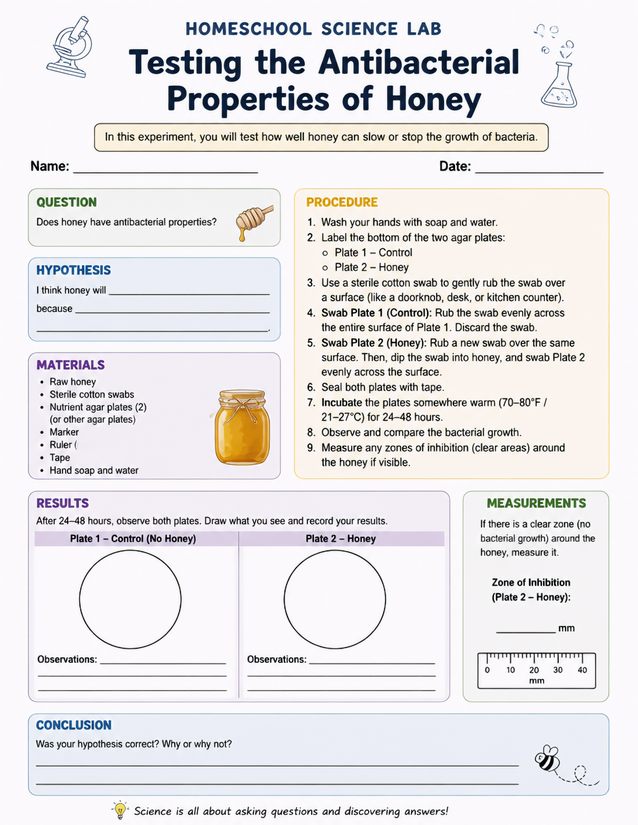
Does honey stop bacteria? This antibacterial properties of honey lab guides grades 5-8 homeschoolers through a 24-48 hour agar plate experiment.
Exploring the Antibacterial Properties of Honey Lab Step by Step

Usage Notes
Raw honey, sterile cotton swabs, a marker, ruler, and tape are all household items. The two nutrient agar plates are the only specialty supply and can be ordered online in small quantities. The procedure specifically asks students to wash their hands before starting and to handle the sealed plates carefully during the incubation period, so walk your student through basic lab hygiene before they begin.

Printing Tips
A 24-pound or heavier paper stock holds up better if plates get moved around during the 48-hour wait and students return to record observations in stages. Clip the loose sheet to a clipboard near the incubation spot so your homeschooler can sketch results without moving their setup.