Creative Minds 𖹭 Happy Hearts

Testing the Antimicrobial Properties of Essential Oils Lab Sheet
Four oils, one control disc, and a data table waiting to be filled in: the antimicrobial properties of essential oils have never made for a more satisfying experiment to watch unfold over 24 to 48 hours.
Your student places paper discs soaked in tea tree, lavender, lemon, and peppermint oils onto agar plates, then measures the zone of inhibition that forms around each disc after incubation. The sheet walks through all eight procedure steps, from labeling the plate to recording disc diameters in millimeters, and includes a data table with columns for zone diameter, average, and observations. Four reflection questions ask students to compare results across oils and reason about what the data suggests, making this a strong fit for grades 5 through 8.
The testing the antimicrobial properties of essential oils lab works well as a standalone experiment or as part of a microbiology or health science unit study. A student who completes it demonstrates the ability to run a controlled experiment, collect quantitative measurements, and draw a reasoned conclusion, skills that transfer directly into more advanced lab work. The conclusion prompt asks for two to four sentences, which is enough to show genuine scientific reasoning without overwhelming a younger secondary student.
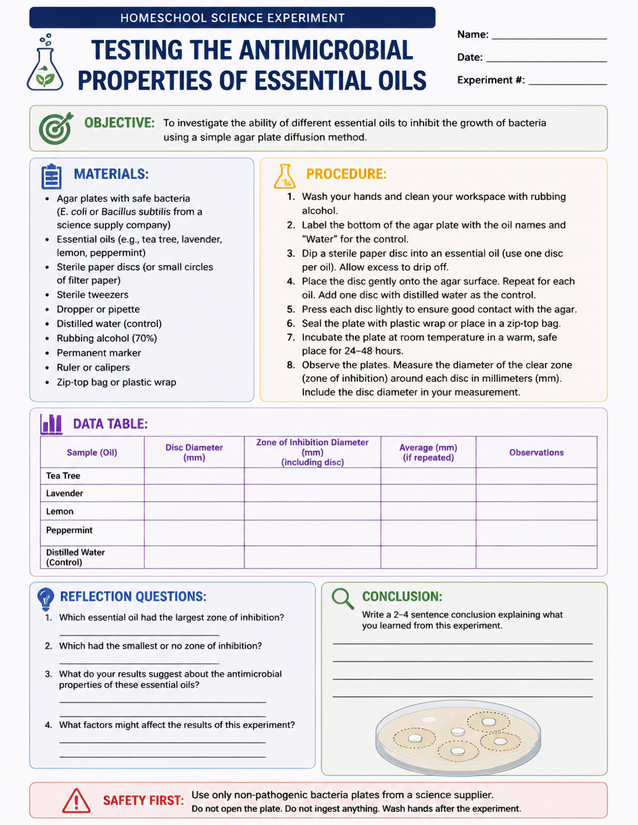
Grades 5-8 homeschoolers investigate the antimicrobial properties of essential oils using agar plates and a disc diffusion method. Instant download.
Investigating the Antimicrobial Properties of Essential Oils in Your Homeschool Lab

Usage Notes
Agar plates with safe non-pathogenic bacteria such as E. coli or Bacillus subtilis must be ordered from a science supply company, so plan ahead by at least a week. Sterile paper discs, tweezers, rubbing alcohol, and a ruler are also on the list, though a permanent marker, zip-top bag, and distilled water are standard household items. The sheet includes a prominent safety note: keep the plate sealed at all times, do not ingest anything, and wash hands after handling.

Printing Tips
Print on 24-pound or heavier paper so the sheet holds up flat while your student measures zones of inhibition with a ruler without the page shifting. Slip it into a plastic page protector inside a lab notebook once measurements are recorded, or clip a loose sheet to a hard-surface clipboard during the observation stage.