Creative Minds 𖹭 Happy Hearts

Aspirin on Plant Growth Lab Sheet, 14-Day Observation
Salicylic acid is already inside every plant. This aspirin on plant growth lab sheet asks your student to find out what happens when you add more from the outside.
Your student labels two pots, one control and one aspirin, plants the same fast-growing seed in each, and then tracks both over 14 days using the data table on this aspirin on plant growth lab sheet. They record plant height in centimeters and leaf count at Day 0, Day 2, Day 4, Day 7, Day 10, and Day 14, with a notes column for anything unexpected. The hypothesis section asks for a written prediction before the experiment begins, grounding the work in the scientific method. This lab fits grades 4-7 and works as a standalone two-week unit study project or as part of a broader plant biology sequence on how chemicals influence living systems. By the time your homeschooler reaches the Analysis and Conclusion section, they have real comparative data to interpret, making it a genuine exercise in drawing evidence-based conclusions rather than simply following directions.
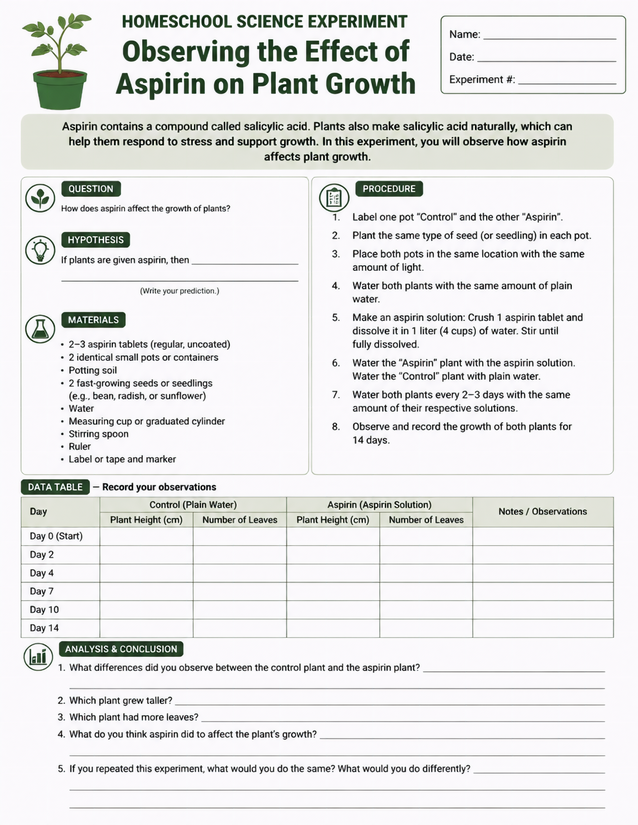
Track how salicylic acid affects seedlings with this aspirin on plant growth lab sheet, designed for grades 4-7 homeschoolers.
Investigating Aspirin on Plant Growth Lab Sheet Results

Usage Notes
Materials are almost entirely household items: aspirin tablets (regular, uncoated), two small pots, potting soil, fast-growing seeds such as bean, radish, or sunflower, water, a measuring cup, a stirring spoon, a ruler, and labels or tape with a marker. The one item that may need a quick store trip is uncoated aspirin, since coated tablets will not dissolve cleanly. No open flames or hazardous chemicals are involved, though students should wash hands after handling soil.

Printing Tips
Standard 20 lb copy paper works for this sheet, but 24 lb holds up better if your student rests it on a clipboard beside the pots during daily measurement sessions. Laminating the data table section is not practical here since students need to write new entries every few days over two weeks.