Creative Minds 𖹭 Happy Hearts

Bean Seed Development Lab Sheet, Clear Glass Container Method
Four beans pressed against glass tell a better germination story than any textbook diagram. This bean seed development lab sheet gives your student fourteen days of rows to capture exactly what happens, root by root.
Suited for grades 2-5, this bean seed development lab sheet walks your student through a two-week germination observation using clear glass containers so roots and shoots are visible without disturbing the seeds. Students record plant height in centimeters each day, sketch or describe what they see in the ‘What I See’ column, and note any changes, giving them a complete picture of how a seed coat splits, roots anchor downward, and a shoot pushes toward light. The guided question is ‘How do bean seeds develop and grow over time?’ and your student begins by writing a hypothesis before touching a single seed.
The sheet stands alone as a unit study anchor for a plant biology or life cycles sequence. Reflection questions at the close ask what changed first, what happened to the seed coat, and what the roots and shoot did over time, so your student must synthesize fourteen days of observation into real conclusions. Completing the bean seed development lab sheet demonstrates understanding of germination stages, directional growth, and basic plant structure, skills that build cleanly into photosynthesis or botany unit work.
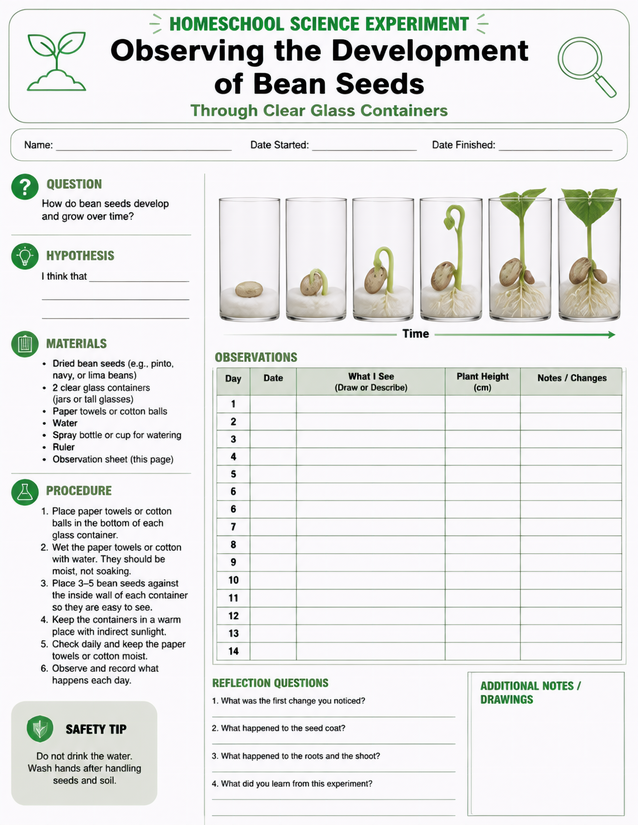
A bean seed development lab sheet for grades 2-5 homeschoolers, tracking daily root and shoot growth through clear glass containers over fourteen days.
Getting Started with Your Bean Seed Development Lab Sheet

Usage Notes
Every item on the materials list is a household or grocery store find. Dried beans (pinto, navy, or lima), two clear glass jars or tall glasses, paper towels or cotton balls, water, a spray bottle or cup, and a ruler are all you need. The safety tip on the sheet reminds students not to drink the water used in the experiment and to wash hands after handling seeds, so keep that step visible during setup.

Printing Tips
Standard 20 lb printer paper works, but 24 lb copy paper holds up better when students press a ruler against the page to record measurements each day. Slip the sheet into a clear page protector inside a science lab notebook, or keep it loose on a clipboard next to the containers so your student can fill it in without moving anything.