Creative Minds 𖹭 Happy Hearts

Brine Shrimp Hatching Lab Sheet, Salt Concentration Experiment
Five cups, five salt concentrations, and one very specific question: your student is about to find out exactly where brine shrimp hatching slows down or stops. This brine shrimp hatching lab sheet walks them through every step.
Your student sets up five cups of dechlorinated water at 0, 10, 20, 30, and 40 g/L of non-iodized salt, adds an equal measure of brine shrimp eggs to each, and counts nauplii after 24 hours. The brine shrimp hatching lab sheet includes a structured hypothesis frame, a materials checklist, a seven-step procedure, a data table with a notes column, and five analysis questions that push students to identify patterns and suggest improvements. It suits grades 5 through 7 and covers variables, controlled conditions, and data interpretation in a single sitting.
This lab fits naturally into a unit study on aquatic biology, adaptation, or osmosis, and it works equally well as a standalone investigation into environmental variables. Because the procedure spans 24 to 48 hours, it teaches your homeschooler to plan an experiment across multiple days rather than wrap everything up in one session. Completing the sheet demonstrates that your student can write a conditional hypothesis, maintain controlled variables across five trials, and draw evidence-based conclusions from a real data table.
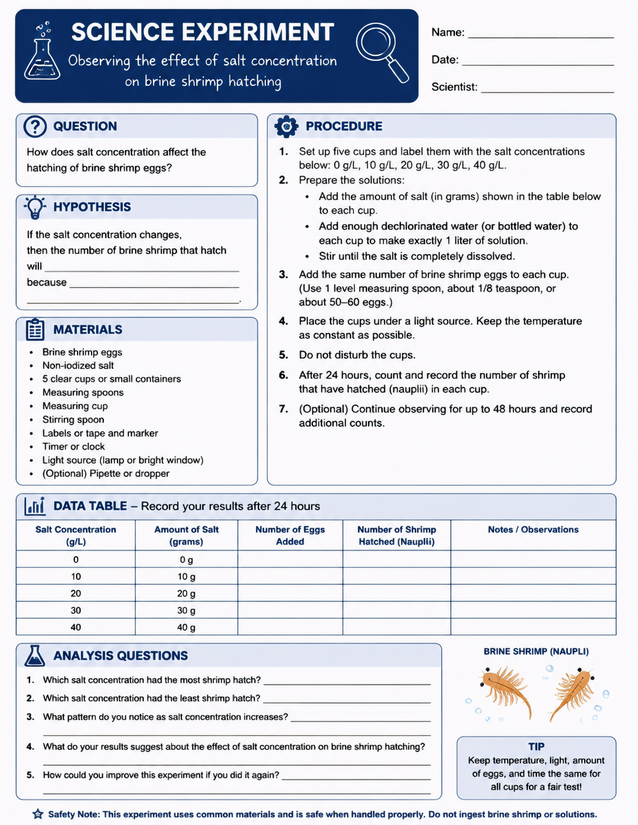
Five salt concentrations, one question: the brine shrimp hatching lab sheet for grades 5-7 records nauplii counts at 0 to 40 g/L.
Getting Started with Your Brine Shrimp Hatching Lab Sheet

Usage Notes
Brine shrimp eggs and non-iodized salt are the two specialty supplies here. Everything else on the materials list, including five clear cups, measuring spoons, a stirring spoon, labels, and a timer, is likely already in your home. The sheet includes a safety note reminding students not to ingest brine shrimp or any of the salt solutions, so review that with younger students before setup begins.

Printing Tips
A 24-lb or heavier paper stock holds up better when the sheet sits near cups of water for two days. Print one copy per student and slip it into a plastic page protector or clipboard for the observation period, keeping the data table accessible without the risk of water damage.