Creative Minds 𖹭 Happy Hearts

Building a Gyroscope Lab Sheet, Angular Momentum Homeschool Science
A CD, a wooden skewer, and two washers are all it takes to make angular momentum visible. Building a gyroscope lab sheet like this one turns that moment of wobble and resistance into a recorded science lesson.
Designed for grades 5 through 8, this lab sheet walks your student through constructing a simple gyroscope using a CD or DVD as the spinning wheel, a wooden skewer as the axle, and washers as low-friction bearings. Four structured observation activities ask your homeschooler to spin the gyroscope, tilt the axis, rotate the wheel from vertical to horizontal, and observe free precession on the table, recording what they notice each time.
The building a gyroscope lab sheet fits naturally into a physics unit study on forces, motion, or rotational mechanics, and it stands on its own as a memorable hands-on experiment. A vocabulary panel defines angular momentum, axis, gyroscope, and precession, so your student builds scientific language alongside the physical model. The Think and Explain section asks four written-response questions that demonstrate whether your student can connect their observations to the underlying concept, not just describe what they saw.
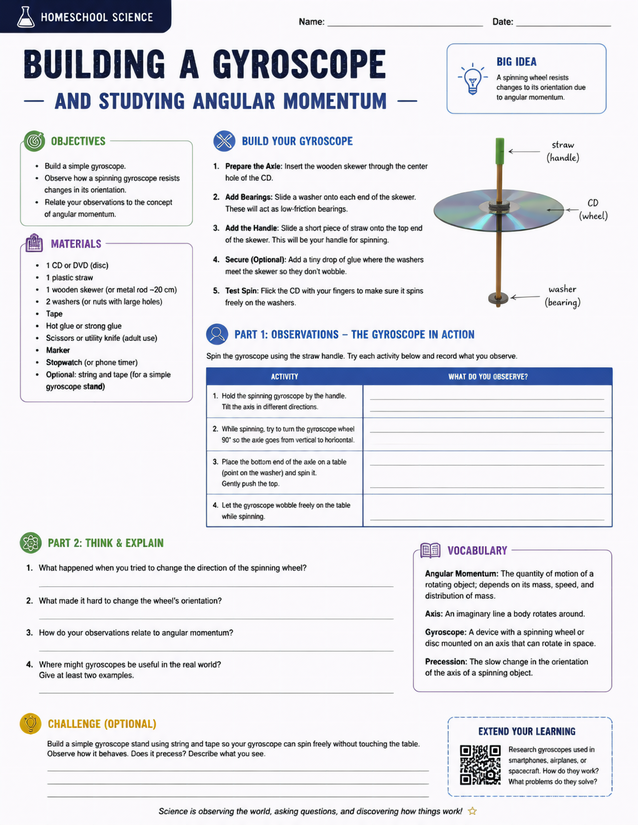
Your student constructs a CD gyroscope and records real observations with this building a gyroscope lab sheet, suited for grades 5-8.
Getting Your Student Started with the Building a Gyroscope Lab Sheet

Usage Notes
Most materials on this sheet are genuine household items: a CD or DVD, a plastic straw, and two washers or large-holed nuts. The wooden skewer or metal rod, roughly 20 cm, may need a quick hardware store stop. Hot glue or strong glue is listed as optional for securing the washers, so adult supervision is appropriate for younger students handling that step.

Printing Tips
Use 24 lb paper rather than standard copy weight so the observation table holds up under pencil pressure and repeated erasing during the experiment. A loose sheet on a clipboard works well here since your student will be spinning and handling the gyroscope at the same time.