Creative Minds 𖹭 Happy Hearts

Building a Homemade Geodesic Dome, Toothpick and Marshmallow Engineering Lab
Toothpicks and marshmallows turn into a structural engineering lesson when your student works through building a homemade geodesic dome from the first triangle to a full strength-tested dome.
Building a homemade geodesic dome walks your student through the geometry of triangles and hexagons as the foundation of one of the strongest architectural shapes in nature and engineering. The sheet guides grades 4 through 7 from forming a six-triangle hexagon base, adding rows of triangles, closing the dome, and then pressing light objects onto the finished structure to test load-bearing strength. Students record toothpick and marshmallow counts at each stage in a built-in observation table, making the math of the build visible alongside the science.
This lab fits cleanly into a geometry unit study, a structures and forces unit, or a Charlotte Mason nature-of-design lesson. Your homeschooler can run it standalone in a single session or pair it with research into real-world geodesic dome applications, which the conclusion questions prompt directly. Completing it demonstrates understanding of triangular stability, structural load distribution, and the engineering design process.
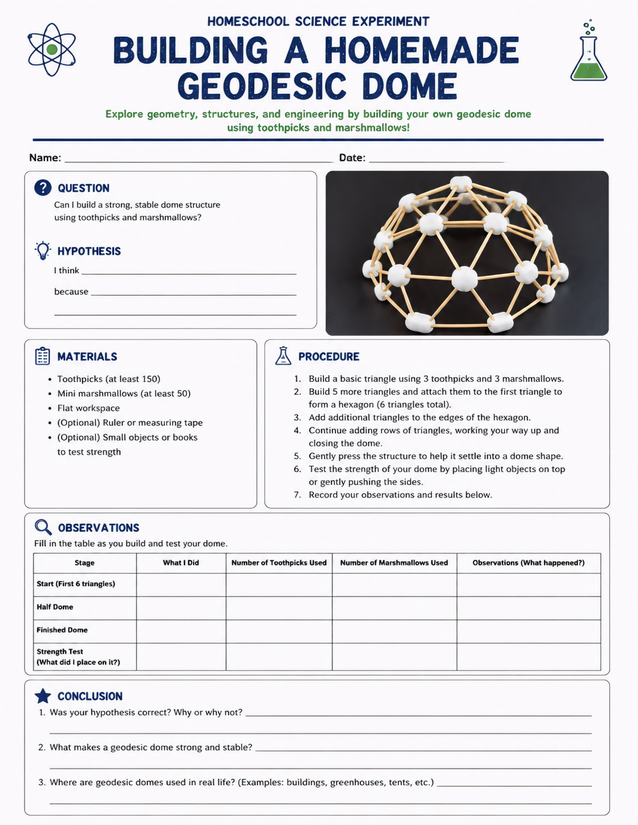
Explore geometry and structural engineering with this building a homemade geodesic dome worksheet, suited for grades 4 through 7.
Setting Up Building a Homemade Geodesic Dome in Your Homeschool Lab

Usage Notes
Toothpicks and mini marshmallows are the core supplies, with the sheet recommending at least 150 toothpicks and 50 marshmallows. Both are standard grocery store items, so no specialty sourcing is needed. The optional strength-test step uses small books or objects already in your home, and younger students should be reminded that toothpick tips are sharp during the building phase.

Printing Tips
Twenty-four pound paper gives the observation table enough body to write on comfortably mid-build without the sheet curling from a damp workspace. Print one sheet per student and clip it to a rigid board so it stays flat while hands are busy assembling triangles.