Creative Minds 𖹭 Happy Hearts

Building a Homemade Telescope with Lenses, Science Lab Sheet
Two convex lenses, a cardboard tube, and about thirty minutes are all that stand between your student and a working telescope. Building a homemade telescope with lenses makes focal length a concept they can actually see.
Building a homemade telescope with lenses walks students in grades 4 through 6 through constructing a functional refracting telescope using a cardboard tube, two convex lenses of different focal lengths, cardboard circles, tape, and black paper or paint. The sheet structures the build across six numbered steps, from lining the tube to adjusting lens distance for a sharp image, and the Observe and Record section asks students to write what they saw, rate image clarity on a five-point scale, sketch the view through the eyepiece, and identify what they would improve.
This lab fits naturally into a light and optics unit study or a physics sequence covering refraction and magnification. Used standalone, it still delivers a complete inquiry cycle: your homeschooler forms expectations before the build, tests them at the eyepiece, and writes a conclusion that connects the lens spacing math shown in the Focusing Tip panel to what they actually observed. Completing the sheet demonstrates understanding of how convex lenses bend light to produce a magnified image of a distant object.
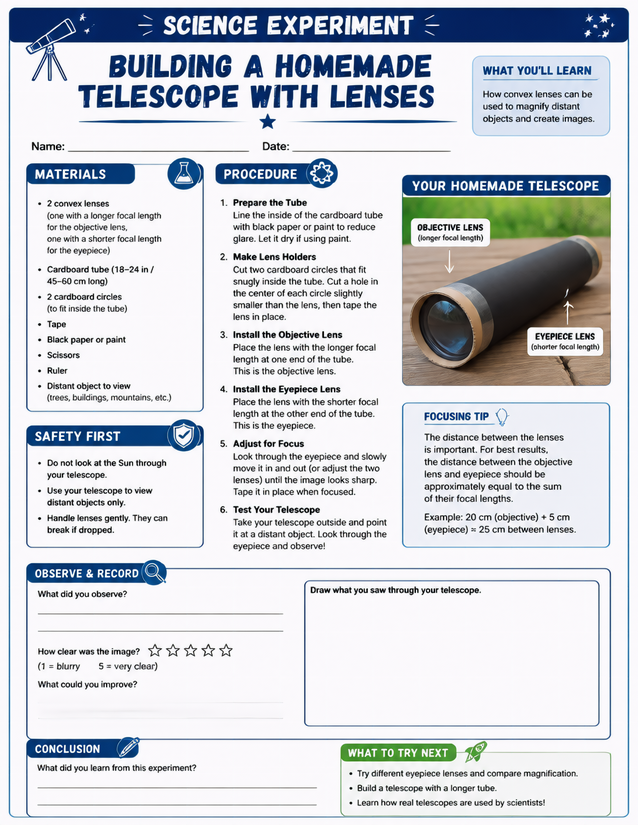
Cardboard tubes and two convex lenses are all it takes. Building a homemade telescope with lenses teaches grades 4-6 real optics principles.
Getting Started with Building a Homemade Telescope with Lenses

Usage Notes
Two convex lenses are the one specialty item here. Everything else, including a cardboard tube 18 to 24 inches long, tape, scissors, a ruler, and black paper or paint, is a household or craft-drawer staple. The sheet includes a dedicated Safety First panel reminding students never to point the finished telescope at the Sun, so review that section with your homeschooler before the build begins.
Printing Tips
Sixty-pound or heavier paper holds up during the build when the sheet sits on a workbench next to scissors and tape. Print single-sided so your student can clip it to a clipboard and reference the procedure steps hands-free while assembling the tube.