Creative Minds 𖹭 Happy Hearts

Building a Model of an Earthquake-Proof Building, Shake Table Included
Craft sticks, rubber bands, and a tray full of shaking are all it takes for building a model of an earthquake-proof building your student will actually want to test twice.
Building a model of an earthquake-proof building asks your student to design, construct, and shake-test at least two different building models made from craft sticks or toothpicks, hot glue, cardboard, and rubber bands. The sheet walks through planning designs, setting up a simple shake table using a tray raised on books, timing how long each model survives, and recording results across three trials per design before calculating an average. Written for grades 5 to 8, the lab connects structural engineering concepts to real seismic science without needing specialized equipment.
This experiment fits naturally into an earth science or physics unit study on natural disasters, forces, or engineering design. It works as a standalone hands-on lesson or as part of a longer sequence on how humans adapt structures to their environment. When your homeschooler completes the results table and reflection questions, they demonstrate not just building skills but the ability to interpret repeated trial data and revise a design based on evidence.
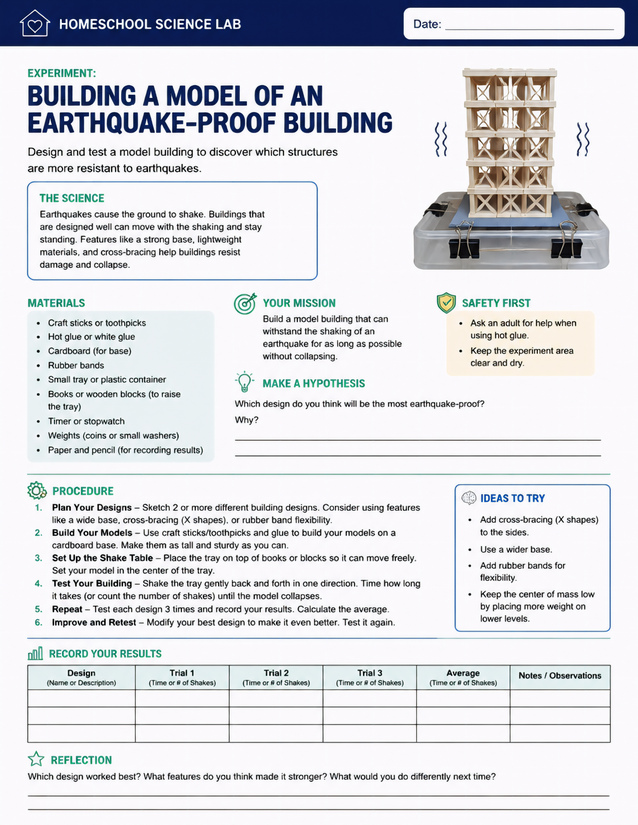
Grades 5 to 8 will love building a model of an earthquake-proof building using craft sticks, cardboard, and rubber bands. Instant download.
Setting Up Building a Model of an Earthquake-Proof Building

Usage Notes
Hot glue is the one supply that requires adult supervision, and the sheet flags this directly in its Safety First box. Craft sticks or toothpicks, cardboard, rubber bands, a small tray or plastic container, books or wooden blocks, and coins or small washers as weights are all household items. Nothing on the materials list requires a specialty science store.

Printing Tips
Twenty-four pound or heavier paper keeps the results table writable without bleed-through when students press hard with a pencil during timed trials. Loose sheets on a clipboard work well at the shake table so the paper does not shift while your student is recording.