Creative Minds 𖹭 Happy Hearts

Building a Simple Seismograph, Cardboard Box Edition
A suspended weight, a spinning paper drum, and a marker line that wiggles with every shake: building a simple seismograph turns earthquake science into something your student can hold in their hands.
Building a simple seismograph is the experiment on this sheet, and it walks students through constructing a working ground-motion recorder from a cardboard box, a toilet paper roll, string, and a small weight such as a washer or bolt. The seven-step instructions guide your homeschooler from building the frame to testing different shake intensities and comparing the wavy lines the pen records on the paper drum. It suits grades 4 through 6 studying earth science, forces, or waves.
The observations section asks three targeted questions about light taps versus strong shakes and how speed and intensity change the recorded line, while the Think and Learn section pushes students to connect their model to real seismograph technology. Building a simple seismograph works well as a standalone hands-on lesson or as an anchor activity inside a unit study on natural disasters, plate tectonics, or scientific instrumentation. Completing it demonstrates an understanding of inertia, relative motion, and how scientists translate invisible forces into readable data.
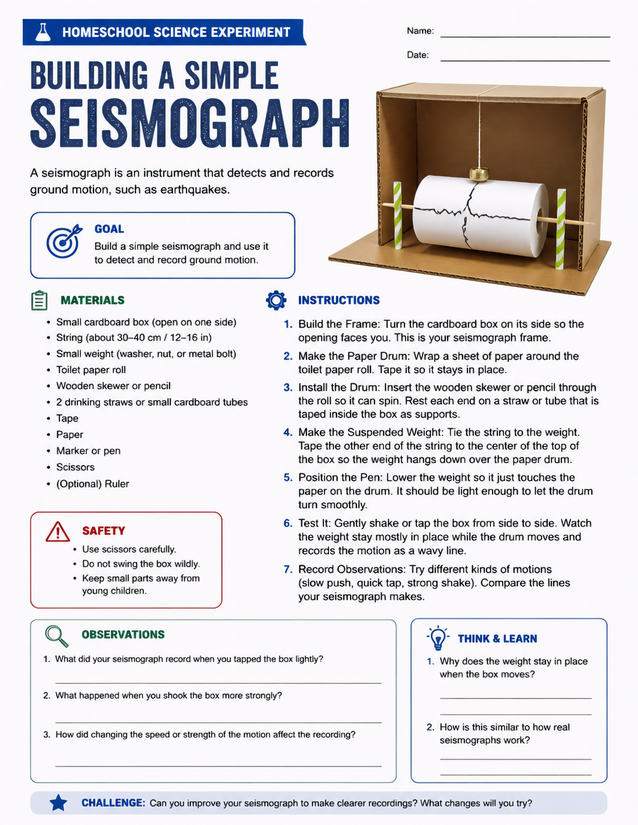
Ground motion becomes visible when building a simple seismograph in grades 4-6. Every material on this sheet is a household item.
Investigating Building a Simple Seismograph Step by Step

Usage Notes
Almost every item on the materials list is already in most homes: a cardboard box, a toilet paper roll, tape, string, a wooden skewer or pencil, drinking straws, and a small weight like a washer or metal bolt. Scissors are the only tool that carries a safety note, and the sheet flags them explicitly alongside a reminder to keep small parts away from young children. No specialty supplies are needed.
Printing Tips
A 24-pound copy paper works fine here since students write short observation responses rather than lengthy notes. Slide the finished sheet into a lab notebook or keep it loose on a clipboard next to the build so your student can jot results the moment each test run finishes.