Creative Minds 𖹭 Happy Hearts

Building a Simple Water Filter, Using Gravel, Sand, and Charcoal
Dirty water goes in, cleaner water comes out, and your student records exactly what changed. Building a simple water filter is one of those experiments where the result is visible right in front of them.
Building a simple water filter is the central task on this lab sheet, which walks students through constructing a layered filtration system using gravel, sand, and activated charcoal inside a cut plastic bottle. Students record observations before and after filtering, note what visibly changed, and answer conclusion prompts asking whether the filter worked and why. The sheet includes a clearly labeled filter setup diagram and a structured hypothesis section, making it a strong fit for grades 4-6 science.
This lab works well as a standalone unit on water systems, environmental science, or simple chemistry, and it pairs naturally with lessons on the water cycle or natural resource conservation. Completing the sheet asks your student to compare variables, draw a conclusion from direct observation, and think critically about how the design could be improved, skills that build scientific reasoning over time.
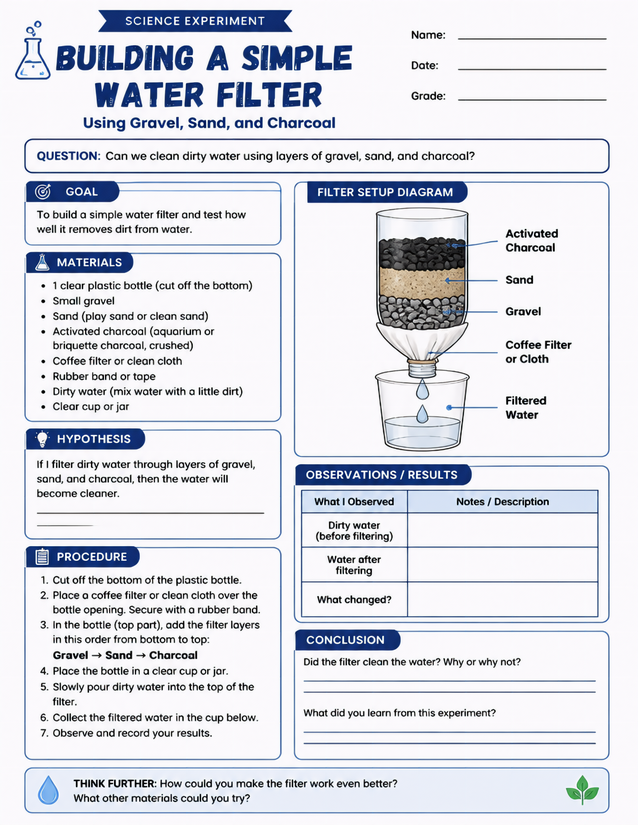
Can dirty water be cleaned with gravel, sand, and charcoal? This building a simple water filter lab sheet is ideal for grades 4-6 homeschoolers.
Investigating Building a Simple Water Filter, Layer by Layer

Usage Notes
Most materials on this sheet are easy household or hardware-store finds: a clear plastic bottle, small gravel, play sand, a coffee filter, and a rubber band. Activated charcoal is the one item that may require a quick trip to an aquarium supply store or a pet section. Cutting the bottom off the plastic bottle is a step that calls for adult help with scissors or a craft knife before students take over the assembly.

Printing Tips
Standard copy paper works for a one-time experiment, but 28-pound paper holds up better when wet hands are involved during setup. Clip a loose sheet to a clipboard so your student can write observations right at the experiment station without wrestling with a notebook.