Creative Minds 𖹭 Happy Hearts

Building a Trebuchet Lab Sheet, Projectile Motion Data Table
Launch angles, counterweights, and foam balls: building a trebuchet lab sheet turns medieval engineering into a hands-on physics lesson your student will not forget.
Your student builds a working trebuchet from craft sticks, a dowel rod, and a counterweight, then systematically tests launch angles from 20 to 60 degrees, recording horizontal distance across three trials for each angle. The data table on this building a trebuchet lab sheet captures Trial 1, Trial 2, Trial 3, and an average column so students practice calculating means alongside gathering physical evidence. Designed for grades 5 to 8, it bridges introductory physics vocabulary like trajectory and projectile with a build-and-test format that suits hands-on learners.
Four analysis questions push past data collection into reasoning: students identify which angle produced the greatest range, explain how changing the angle affected distance, predict what a heavier counterweight would do, and name other variables that might matter. That sequence works well as the capstone of a simple machines unit study or as a standalone investigation inside a forces and motion block. Completing the sheet demonstrates both controlled-variable experimental design and the ability to draw evidence-based conclusions.
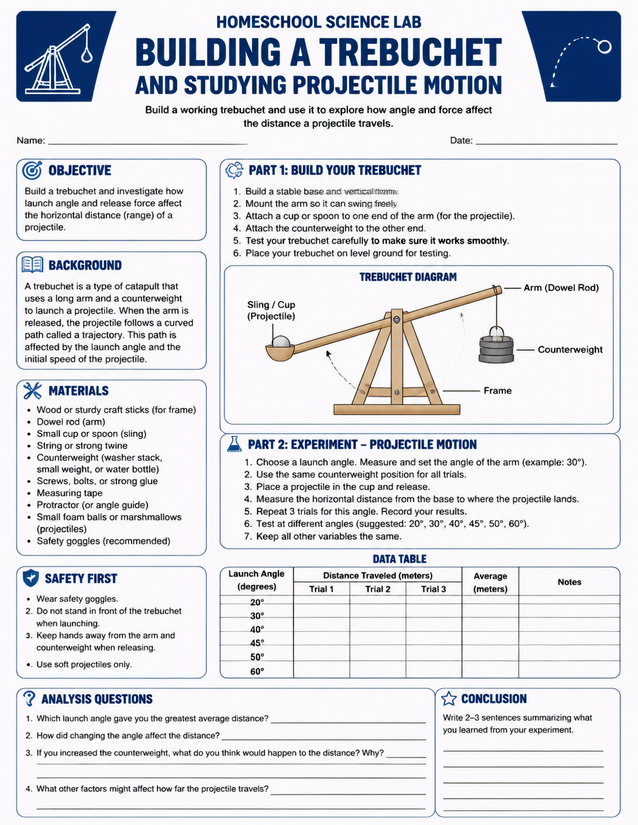
Explore launch angle and force with this building a trebuchet lab sheet for grades 5-8 homeschoolers. Includes a data table and analysis questions.
Investigating Building a Trebuchet Lab Sheet, Angle by Angle

Usage Notes
Wood craft sticks or balsa strips, a dowel rod, string or strong twine, and a counterweight such as a washer stack or small water bottle make up the build. Safety goggles are listed as recommended on the sheet, and the safety section specifically warns students to keep hands clear of the arm and counterweight during release. Small foam balls or marshmallows serve as projectiles, keeping the activity safe for indoor or outdoor testing.
Printing Tips
Twenty-four-pound copy paper is fine for the data table portion, but if your student will be outdoors measuring throws with a tape measure, a single laminated sheet clipped to a clipboard holds up against wind and damp ground. Alternatively, slip it into a clear plastic page protector and record with a wet-erase marker, then transfer final averages to a clean printed copy for the lab notebook.