Creative Minds 𖹭 Happy Hearts

Testing the Buoyancy of Different Objects in Salt vs Fresh Water
Fresh water and salt water look identical in a cup, but drop in a marble and the difference becomes impossible to ignore. This buoyancy of different objects lab makes that contrast measurable and recordable.
Your student begins by forming a hypothesis about how salt concentration affects whether objects float, sink, or stay suspended, then works through a six-step procedure using two labeled containers and up to eight small household objects. The data table tracks each object’s behavior in fresh water and salt water side by side, with columns for float, sink, or suspended status and a yes-or-no column for whether behavior changed between the two liquids. A science tip box on the sheet explains the density relationship that drives the results, giving your homeschooler a conceptual anchor before they draw conclusions. This is a well-matched buoyancy of different objects lab for grades 3-6.
The sheet works as a standalone investigation or as an anchor activity inside a broader unit study on density, ocean science, or physical properties of matter. Completing the observation and conclusion sections asks your student to move from raw data to a pattern-based claim, which is exactly the kind of reasoning that builds scientific literacy over time. A cleanup note at the bottom reminds students to dispose of salt water away from plants and to rinse all materials, which makes end-of-experiment habits part of the lesson.
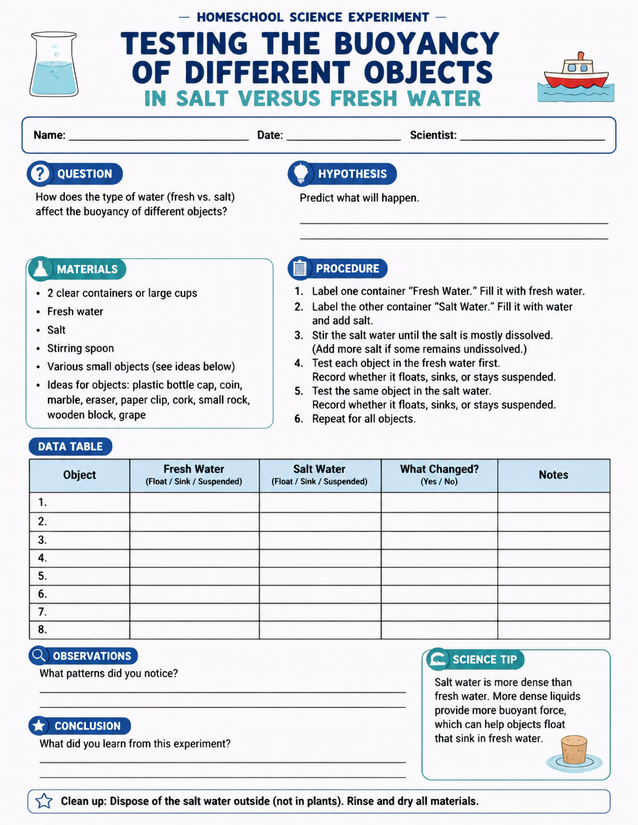
Explore the buoyancy of different objects lab with grades 3-6 homeschoolers using household materials and a clear data table.
Getting Started with the Buoyancy of Different Objects Lab

Usage Notes
All materials listed are household items: two clear containers or large cups, fresh water, salt, a stirring spoon, and small objects such as a coin, marble, eraser, paper clip, cork, small rock, wooden block, or grape. No specialty supplies are required. Salt water disposal away from plants is the one safety note the sheet flags explicitly.
Printing Tips
Standard 20-pound copy paper works fine here since students are circling words and writing brief notes rather than pressing hard. Slip the sheet into a plastic page protector inside a lab notebook if you want to keep the experiment record intact after the containers get wet on the table around it.