Creative Minds 𖹭 Happy Hearts

Testing the Burning Rate of Different Candle Wax Types
Paraffin, soy, or beeswax: testing the burning rate of different candle wax teaches your student that chemistry shows up in everyday objects, measured in grams per minute.
This lab sheet walks students in grades 5-8 through a controlled comparison of three candle wax types: paraffin, soy, and beeswax. Students record starting and ending mass in grams after a timed 30-minute burn, calculate mass burned, and then divide by 30 to find the burning rate in grams per minute. The data table labels each candle A, B, and C, so students practice fair-test design alongside their math and observation skills.
The burning rate of different candle wax fits naturally into a chemistry or physical science unit study covering combustion, states of matter, or energy transfer. It works as a standalone lesson or as a complement to lessons on consumer science and natural versus synthetic materials. By the conclusion section, your homeschooler has practiced hypothesis writing, controlled variables, and data-based analysis in a single session.
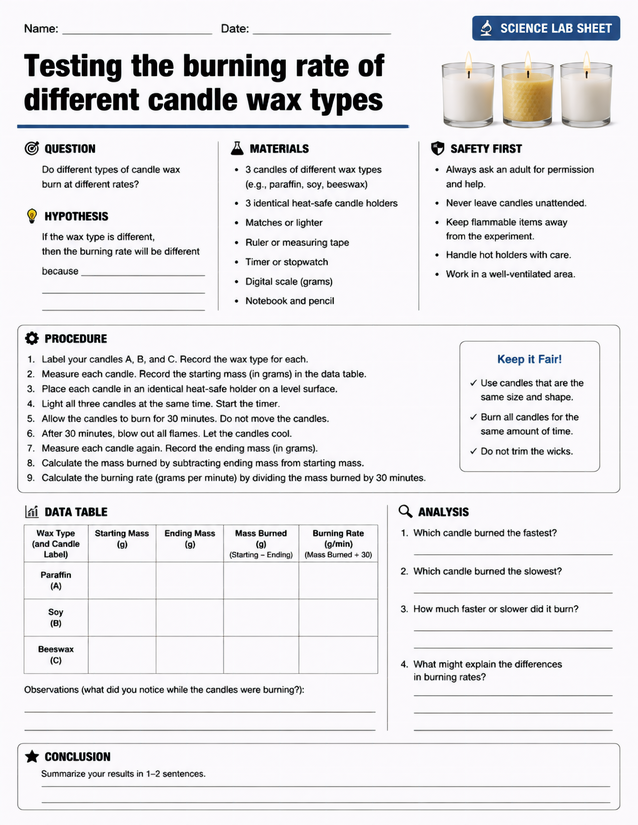
Does wax type change how fast a candle burns? This burning rate of different candle wax lab guides grades 5-8 through a timed, measured experiment.
Investigating the Burning Rate of Different Candle Wax

Usage Notes
Three candles of different wax types are the key supply, and paraffin candles are easy to source while soy and beeswax may require a craft store or online order. The sheet also calls for a digital scale accurate in grams, heat-safe holders, a timer, and matches or a lighter. Because open flames are involved, the sheet includes a dedicated Safety First section reminding students to never leave candles unattended and to work in a well-ventilated area, so adult supervision is required throughout.
Printing Tips
Twenty-pound copy paper is workable, but 24-pound holds up better when students write during a live experiment with damp or warm hands nearby. Slip the sheet into a hard-backed clipboard so students can record mass readings without the page shifting, and keep it as a loose sheet rather than bound into a notebook since it needs to lie flat beside the scale.