Creative Minds 𖹭 Happy Hearts

Caffeine Effect on Reaction Time Lab Sheet, Middle and High School
A cup of coffee or tea becomes the independent variable in this lab sheet tracking the caffeine effect on reaction time before and after consumption, at 30 and 60 minutes.
Your student tests whether caffeine actually speeds up response to a visual stimulus, recording five reaction time trials at baseline, then again at 30 minutes and 60 minutes after consuming roughly 100 mg of caffeine. The sheet walks through hypothesis writing, variable identification (independent, dependent, and controlled), a nine-step procedure, and a data table built for averaging results across all three time points. Designed for grades 6-10, this caffeine effect on reaction time lab sheet suits a middle or high school life science or human biology unit.
The experiment works as a standalone lesson or inside a broader unit study on the nervous system, stimulants, or experimental design. A free online reaction time tester or smartphone app supplies the measurement tool, so no lab equipment is required beyond a caffeine source and a quiet space. By completing the analysis and conclusion section, your homeschooler practices interpreting averaged data, comparing conditions, and writing a data-supported explanation for their results.
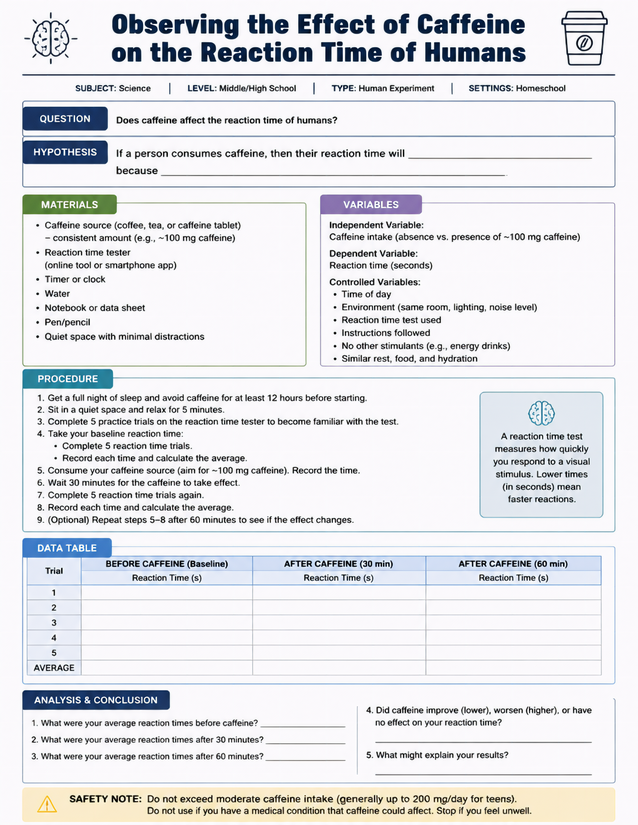
Record the caffeine effect on reaction time across three test intervals with this homeschool science lab sheet for grades 6-10.
Getting Started with the Caffeine Effect on Reaction Time Experiment

Usage Notes
Most materials here are already at home: water, a pen or pencil, a notebook or the printed data sheet, and a timer. The caffeine source calls for a consistent dose of roughly 100 mg, which a measured cup of coffee or tea can supply. A prominent safety note at the bottom of the sheet flags a daily caffeine limit of 200 mg for teens and advises stopping the experiment if your student feels unwell.

Printing Tips
Standard 20 lb copy paper holds up fine for writing during timed trials, but 24 lb paper prevents any ink bleed if your student uses a felt-tip pen. Slip the sheet into a lab notebook between the before and after sessions, or clip it to a clipboard so it stays flat on the table during all nine procedure steps.