Creative Minds 𖹭 Happy Hearts

Capillary Action Celery Experiment Lab Sheet
Colored water climbing through a celery stalk is capillary action you can actually watch happen. This capillary action celery experiment gives your student a structured way to record exactly how far and how fast that color travels.
Structured for grades 3-6, this lab sheet walks your homeschooler through observing how capillary action moves colored water up through celery stems over a 24-hour window. Students write a hypothesis first, then fill in a timed observation table with entries at the start, one hour, three hours, six hours, and 24 hours, noting what they see and measuring color travel in centimeters. Three analysis questions follow: what changed over time, which color traveled farthest and why, and how the results demonstrate capillary action.
The capillary action celery experiment fits naturally into a plant biology unit or a broader study of how water moves through living things. It works as a standalone lesson or as an early hands-on entry point before covering xylem and phloem in more detail. Completing the sheet asks your student to connect a visible result to an underlying mechanism, which is exactly the kind of reasoning a life science unit needs.
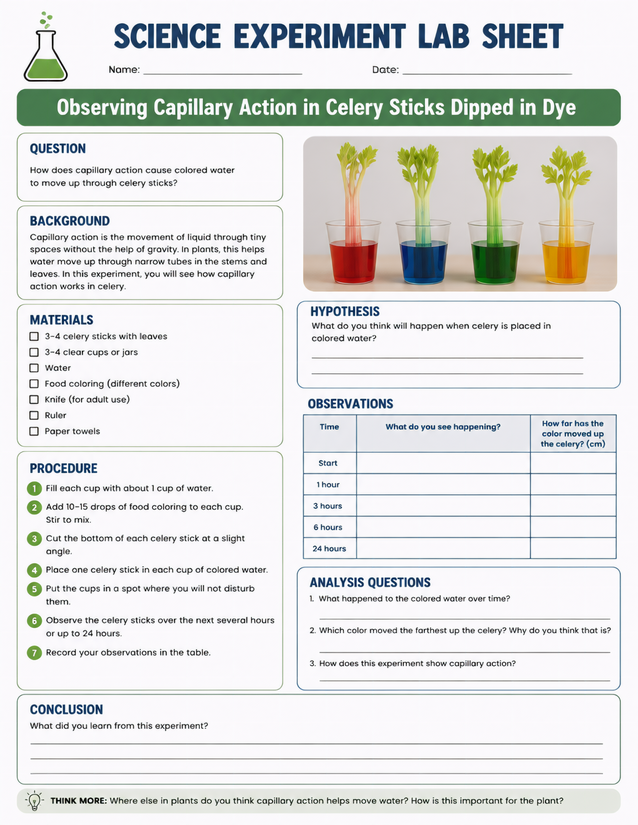
Colored water travels upward through celery stems in this capillary action celery experiment lab sheet for grades 3-6. All household materials.
Exploring the Capillary Action Celery Experiment at Home

Usage Notes
Every material on the list is a household staple: celery sticks with leaves, clear cups or jars, water, food coloring in at least three colors, paper towels, and a ruler for measuring. The one item requiring adult handling is a knife, noted directly on the sheet for cutting each celery base at a slight angle before placing it in the colored water. No specialty supplies are needed.

Printing Tips
Standard 20-lb copy paper works for a loose sheet on a clipboard beside the cups, which makes it easy to update the observation table each time your student checks on the celery. If you want a reusable version, laminate the hypothesis and observation sections and have students write with a dry-erase marker, printing fresh analysis and conclusion pages each time.