Creative Minds 𖹭 Happy Hearts

Capillary Action of Water in Different Soils Lab Sheet
Sand, loam, and clay all hold water differently, and your student can measure exactly how much with this capillary action of water in different soils lab sheet that uses cups from your kitchen.
Your homeschooler investigates how pore size affects water movement by tracking capillary rise in three soil types over 30 minutes. The sheet walks through a full hypothesis, a seven-step procedure, and a results table where students log the original water level, the level after 30 minutes, and the height water rose in centimeters for sand, loam, and clay. Four analysis questions push thinking further, asking which soil showed the highest rise and why the soils produced different results. A Think Further prompt invites your student to design a follow-up experiment testing packed soil or very dry soil. This is a strong fit for grades 4-6 and works naturally inside a unit study on earth science, soil science, or plant biology.
The capillary action of water in different soils experiment stands well on its own as a single-session lab, though it pairs neatly with lessons on plant water uptake or the water table. Completing the sheet demonstrates that your student can form a testable hypothesis, collect and record quantitative measurements, and draw evidence-based conclusions. The Think Further section adds a layer of experimental design that suits students ready to move beyond observation into independent inquiry.
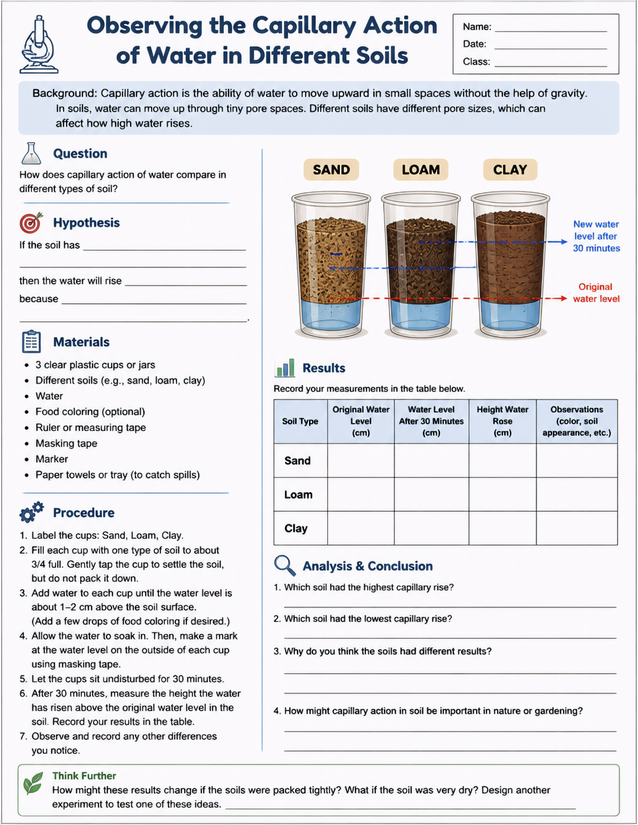
Record how capillary action of water in different soils rises in sand, loam, and clay with this grades 4-6 homeschool lab sheet.
Recording Results for Capillary Action of Water in Different Soils

Usage Notes
Nearly everything on the materials list is already in a typical home: clear plastic cups or jars, water, a ruler, masking tape, a marker, and paper towels. The only item that might need a quick sourcing step is a supply of three distinct soil types. Sand, loam, and clay can often be gathered from a garden center or backyard, and food coloring is listed as optional. No heat sources or chemicals are involved, so safety setup is minimal.

Printing Tips
Standard 20 lb printer paper works for a one-time lab session, but 24 lb paper holds up better if cups are nearby and the sheet gets damp at the edges. Slip it into a clipboard for easy writing during the 30-minute wait, or slide the completed sheet into a lab notebook after recording the final measurements.