Creative Minds 𖹭 Happy Hearts

Cartesian Diver Experiment, Buoyancy Lab Sheet
Squeeze a bottle and a tiny dropper sinks on command. The Cartesian diver experiment turns pressure, density, and buoyancy into something your student can hold in their hands.
Built around the question of how changing pressure affects an object’s position in water, this lab sheet walks students through a full scientific investigation using a clear plastic bottle, an eye dropper, modeling clay, and optional food coloring. Students write a hypothesis, follow a seven-step procedure, and record what happens at four distinct stages: bottle at rest, squeeze gently, squeeze harder, and release pressure. A labeled photo shows exactly how the dropper and clay weight sit inside the filled bottle, so setup is clear before the experiment begins. The explanation section on the sheet connects the observable sinking and floating directly to air compression, water displacement, and the buoyant force, making this a strong fit for grades 3-6 homeschool science.
The Cartesian diver experiment works as a standalone lesson or as an anchor activity inside a unit study on fluid dynamics or states of matter. Your student demonstrates understanding by completing the three-column results table, which asks not just what happened but why they think it happened, building the habit of evidence-based reasoning. Pairing this sheet with a lesson on Archimedes’ principle or Pascal’s law gives older students in grades 5-6 a concrete reference point for more abstract concepts.
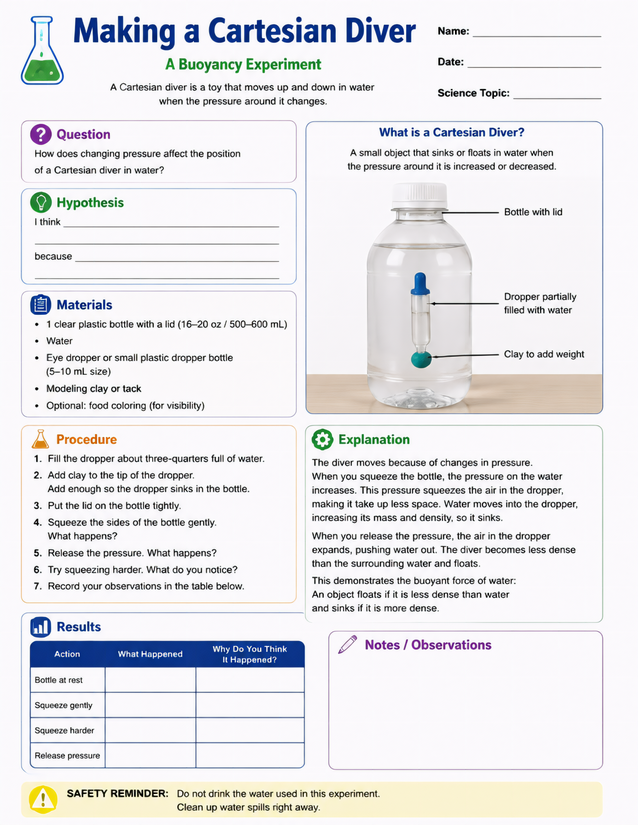
Squeeze a bottle and watch density change: this Cartesian diver experiment lab sheet guides grades 3-6 homeschoolers through buoyancy science.
Investigating the Cartesian Diver Experiment Step by Step

Usage Notes
All materials listed on the sheet are household items: a 16-20 oz plastic bottle with a lid, water, an eye dropper or small plastic dropper bottle, and modeling clay or tack. Food coloring is optional but helps with visibility. The sheet includes a safety reminder to avoid drinking the experiment water and to clean up spills immediately, worth reviewing with your student before you start.

Printing Tips
Standard 20-pound printer paper works fine here since students are writing at a table, not outdoors. Slip the sheet into a plastic page protector if you want to protect it from water splashes during the squeezing steps, or print a second copy as a rough draft for the hypothesis before committing to the final sheet.