Creative Minds 𖹭 Happy Hearts

Cell Membrane Model with Phospholipids, Homeschool Lab Sheet
Phospholipids floating in a shallow dish will actually arrange themselves into a bilayer pattern your student can watch happen in real time. This cell membrane model with phospholipids lab sheet captures every step, from hypothesis to conclusion.
Designed for grades 6-8, this homeschool worksheet walks your student through a hands-on investigation into how phospholipids self-organize in water to form the structure that governs what enters and exits a cell. The sheet opens with a guiding question and a fill-in hypothesis, then moves through a seven-step procedure: filling a shallow dish with water, adding optional food coloring, sprinkling phospholipid model pieces onto the surface, and observing how the hydrophilic heads and hydrophobic tails arrange themselves. A labeled diagram on the sheet identifies both parts of a phospholipid so your student can connect what they see in the dish to the biology vocabulary. An open observations box asks them to draw what they see, and four analysis questions probe how the heads and tails behaved differently.
The cell membrane model with phospholipids fits naturally into a cell biology unit study, sitting well after a lesson on cell structure and before deeper work on membrane transport. Completed independently, it demonstrates that your student can form a testable hypothesis, follow a multi-step lab procedure, and draw evidence-based conclusions. The conclusion section ends with an “I learned that” prompt, giving younger or less confident writers a low-stakes entry point into scientific writing.
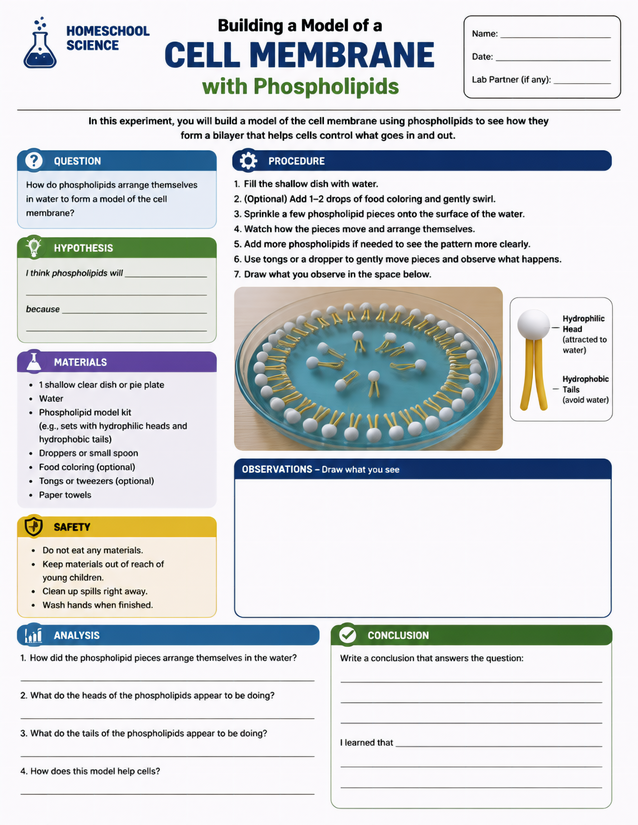
Watch phospholipids self-arrange into a bilayer with this cell membrane model with phospholipids lab sheet for grades 6-8.
Recording Results for Your Cell Membrane Model with Phospholipids

Usage Notes
Materials are a mix of household items and one specialty supply. Water, a shallow clear dish or pie plate, food coloring, paper towels, and a dropper or small spoon are all common kitchen finds. The phospholipid model kit, sets with distinct hydrophilic heads and hydrophobic tails, is the one item to source ahead of time. The safety section flags that no materials should be eaten and spills should be wiped immediately, making this experiment appropriate for independent student work with light supervision.
Printing Tips
Heavier paper in the 60 lb range holds up better if water splashes near the sheet during the experiment. Inserting it into a plastic page protector inside your student’s lab notebook keeps it flat and prevents smearing when they draw their observations immediately after the activity.