Creative Minds 𖹭 Happy Hearts

Common Surfaces Harbor the Most Bacteria Lab Sheet
Doorknobs, phone screens, and refrigerator handles all look clean enough. This common surfaces harbor the most bacteria experiment shows your student exactly which ones are lying.
Swabbing household surfaces and growing colonies on agar plates, your student records real bacterial growth data across up to eight locations over three to five days. The sheet guides grades 5-7 homeschoolers through a structured question, hypothesis prompt, step-by-step procedure, and a results table where colony counts are logged by surface and observation day. The common surfaces harbor the most bacteria investigation builds vocabulary around microbiology and controlled testing without requiring a lab classroom.
This works well as a standalone unit study anchor or as part of a broader microbiology or health science sequence. Four analysis questions push students to explain which surface had the most and least bacteria, flag surprising results, and propose ways to improve accuracy. A conclusion section ties observation back to the opening question, giving your homeschooler a complete scientific write-up by the end.
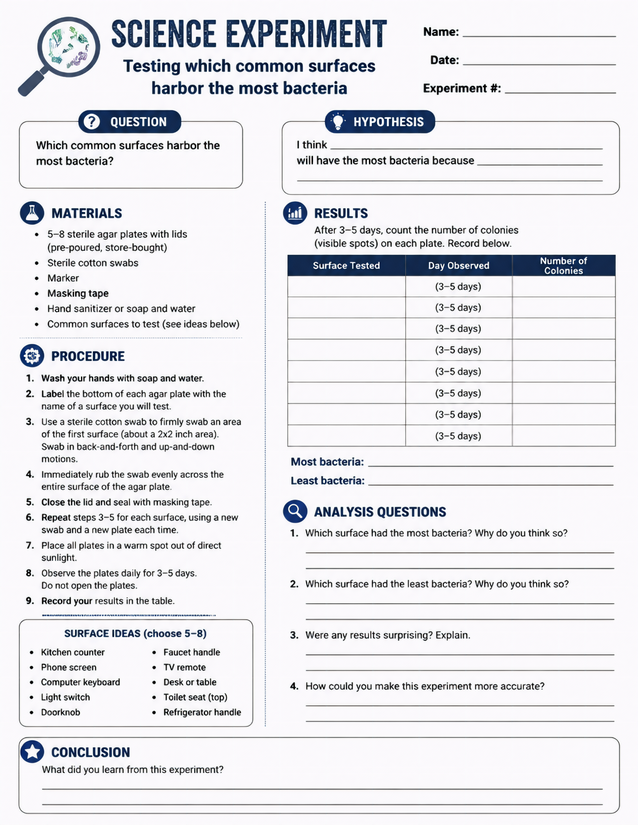
Swab eight household surfaces and count bacterial colonies with this common surfaces harbor the most bacteria lab sheet for grades 5-7.
Investigating Common Surfaces Harbor the Most Bacteria in Your Home

Usage Notes
Pre-poured sterile agar plates with lids are the one specialty supply this sheet requires and they are typically ordered online in packs of five to ten. Everything else on the materials list, sterile cotton swabs, a marker, masking tape, hand sanitizer or soap, and the surfaces themselves, is already in most homes. Students should wash hands before swabbing and must not open sealed plates once the incubation period begins, a safety note the procedure explicitly flags.

Printing Tips
Standard copy paper works fine since all writing happens before and after the incubation period, not during messy lab work. Slip the sheet into a plastic page protector inside your science notebook so it stays clean on the counter while plates are being labeled and sealed.