Creative Minds 𖹭 Happy Hearts

Comparing Fractions Using Benchmarks, Grades 3-4
Benchmark numbers give your student a mental anchor before any cross-multiplication ever enters the picture. Six problems and one open-ended challenge make this comparing fractions using benchmarks sheet a natural next step after equivalent fractions.
The top of the page lays out a reference box explaining how the benchmarks 0, one-half, and 1 work as anchor points, so your student has the rule in view while working. Below that, six fraction pairs ask students to write a less-than, greater-than, or equal sign inside a circle, and each large box leaves room to show thinking in writing. A challenge at the bottom pushes students to generate two fractions that land between one-half and 1, which flips the task from recognition to creation. This homeschool worksheet suits grades 3 and 4 working through fraction comparison strategies.
The reference section makes comparing fractions using benchmarks accessible for independent practice once you have introduced the concept together, since the rules stay visible rather than requiring memorization on the first pass. Students practice reasoning about fraction size relative to a known quantity rather than relying on procedures, which builds number sense alongside computation. The six structured problems move from more obvious pairs like 2/8 versus 1/2 toward less intuitive ones like 7/10 versus 1/2, giving your homeschooler a gentle progression within a single sitting.
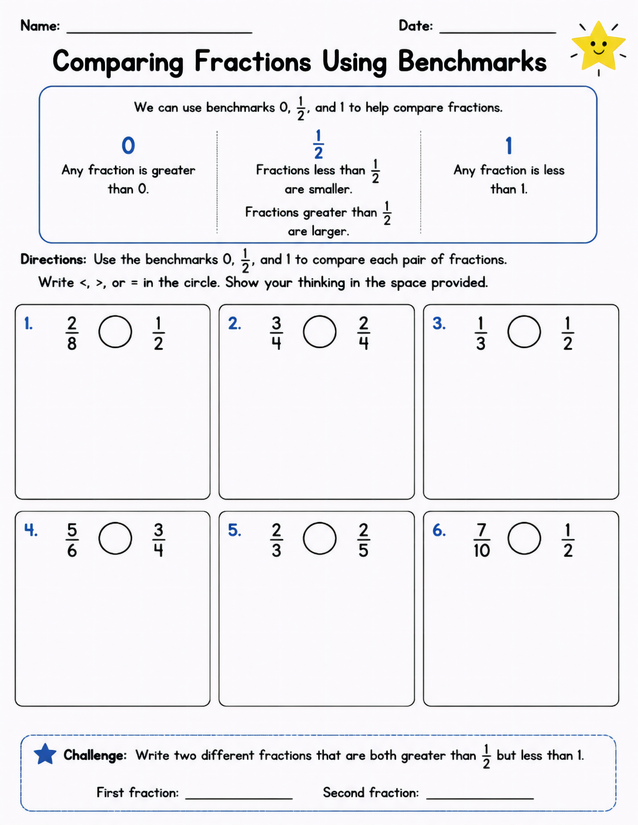
Use benchmarks 0, one-half, and 1 to compare fractions in this comparing fractions using benchmarks worksheet for grades 3-4.
Building Number Sense with Comparing Fractions Using Benchmarks

Usage Notes
Pencil works best here so students can revise their thinking notes inside each box before committing to the inequality symbol. The show-your-thinking space rewards written reasoning, making this a strong fit for guided instruction the first time through and independent practice on review days.

Printing Tips
Copy paper at 20 lb handles pencil erasing without tearing, which matters given the scratch space in each problem box. Portrait orientation is how the layout was designed, and printing two copies lets you use one as a first attempt and one as a clean redo.