Creative Minds 𖹭 Happy Hearts

Concentric Hexagon Tile Coloring Page, Four-Point Stars at Intersections
Stare at the concentric hexagon tile coloring page long enough and the nested squares inside each hexagon start to feel like they’re pulling inward. Pick your palette before you sit down, because once you start, stopping mid-tile is harder than it looks.
Rows of hexagons fill the page edge to edge, each one containing a set of concentric squares that tighten toward a tiny diamond at the center. Where four hexagons meet, a small four-point star emerges from the junction lines, giving the grid a secondary pattern that only reveals itself once you step back.
The concentric hexagon tile coloring page sits firmly in the dense-and-meditative category. Deciding early whether to treat each hexagon as a self-contained unit or to chase a color gradient across the whole grid will shape the entire session. This kind of structured repetition is a staple of the Geometric Designs collection, and the tight line spacing means no zone overstays its welcome.
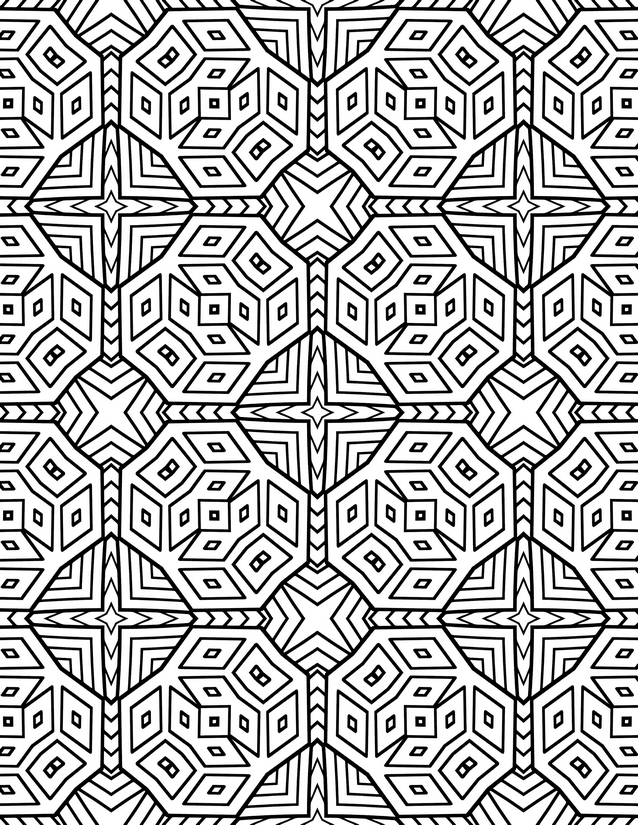
Nested squares inside hexagons, tiny four-point stars at every junction: the concentric hexagon tile coloring page rewards patient colorists. Free instant download.
Where to Start on the Concentric Hexagon Tile Coloring Page

Usage Notes
Blending pencils paired with colored pencils are a natural fit here: the concentric rings are narrow enough that you can burnish each band a slightly lighter shade than the last, giving every hexagon a subtle dimensional pull. Gel pens handle the tiny center diamonds cleanly, since their controlled tip deposits ink without flooding the surrounding lines. Use alcohol markers cautiously on the larger banded sections only, the fine concentric lines sit close enough together that bleed can merge two adjacent rings into one muddy stripe.

Printing Tips
Ninety-pound inkjet paper is worth reaching for on this one. The line density means a standard 20-pound sheet can buckle if you layer wet media, and a warped page makes keeping within those thin concentric bands much harder. Print at 100 percent scale rather than scaling down, the innermost squares become nearly too small to color if the image is reduced.