Creative Minds 𖹭 Happy Hearts

Counting Mixed Coins and Bills Worksheet, Grades 2-3
Real bills, real coins, six problems that actually make your student stop and think before writing a dollar amount.
Each of the six problems on this counting mixed coins and bills worksheet pairs a paper bill with a handful of coins. Students look at the combination in each numbered box and then write the total amount in dollars and cents on the answer line below it. Bills pictured include one-dollar, five-dollar, ten-dollar, and twenty-dollar notes alongside quarters, nickels, dimes, and pennies in varying combinations. This level of challenge suits grades 2 and 3 in your homeschool math curriculum, particularly once your student is comfortable with basic coin values and is ready to bridge to mixed money counting.
The worksheet works well as a short independent assignment after a hands-on money lesson with real or play currency. Because each problem is self-contained in its own bordered box, your student can work through problems one at a time without feeling overwhelmed by the page as a whole. Completing it builds the habit of adding coin values to a bill amount, a foundational skill that connects to making change and budgeting concepts later in your unit study.
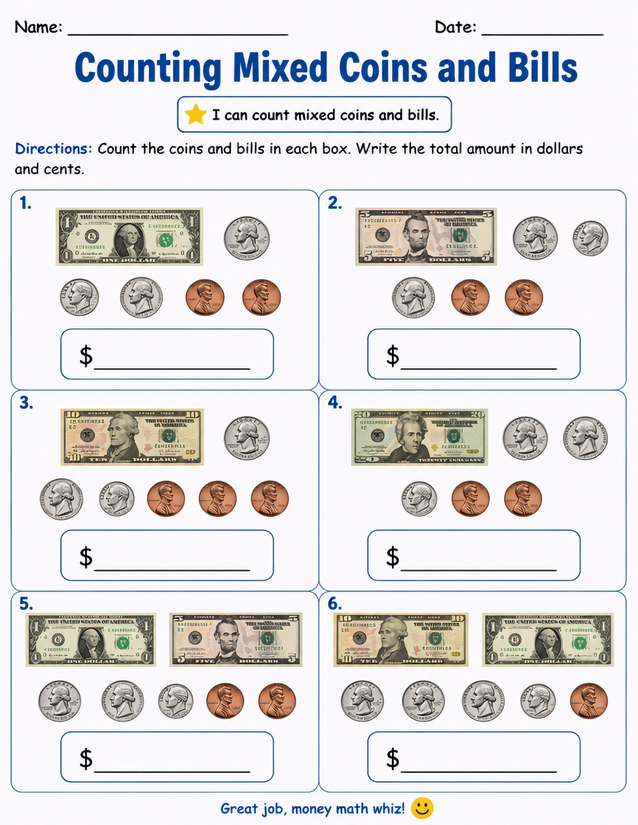
Six money problems ask students to count mixed coins and bills and write totals in dollars and cents. Grades 2-3.
Getting Started with Counting Mixed Coins and Bills

Usage Notes
A pencil works well here since students may need to erase and recount as they add up values. The problems involve multiple coin types alongside bills, so guided instruction on the first problem or two helps younger homeschoolers develop a reliable counting strategy before they work independently.

Printing Tips
Standard 8.5 by 11 paper in portrait orientation keeps the two-column grid clean and easy to read. Print two or three copies at once if your student benefits from repeated practice across separate sessions.