Creative Minds 𖹭 Happy Hearts

Decomposition of Leaves Terrarium Experiment Lab Sheet
Sealed inside a jar, leaves quietly rot, and your student gets to watch every stage. This decomposition of leaves terrarium experiment turns a mason jar on the windowsill into a weeks-long science record.
Built around a closed terrarium made from a clear jar, soil, and dried leaves, this lab sheet walks your grades 3-6 student through a multi-week observation of natural decomposition. The observation table has four dated rows where students log appearance changes, texture shifts (soft, brittle, holey), and signs of decomposition such as mold, insects, or fragments. A “What to Look For” visual panel shows five specific indicators: color changes, texture changes, fungal growth, small creatures, and leaves breaking into smaller pieces, so your student knows exactly what to notice.
The decomposition of leaves terrarium experiment fits naturally into a life science or ecology unit study, whether you are covering nutrient cycles, soil biology, or the role of decomposers in an ecosystem. Four reflection questions ask students to articulate what changed, what caused those changes, which living things helped break down the leaves, and why decomposition matters in nature. A “Think Like a Scientist” prompt at the bottom introduces controlled variable thinking, asking for a prediction and a one-variable change. Completed over two to four weeks, the sheet demonstrates patient scientific observation and connects directly to concepts like the carbon cycle and soil formation.
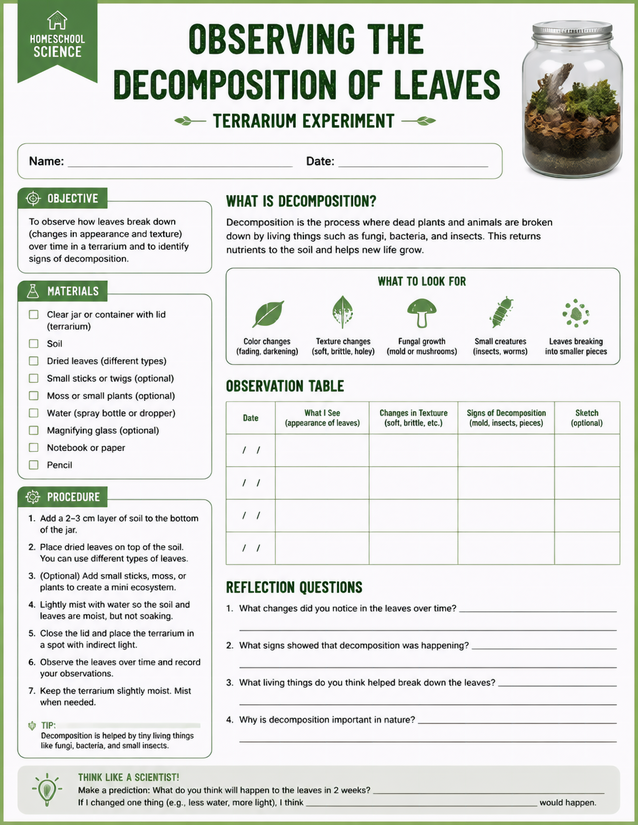
Track fungal growth, color shifts, and texture changes with this decomposition of leaves terrarium experiment for grades 3-6 homeschoolers.
Setting Up the Decomposition of Leaves Terrarium Experiment

Usage Notes
Most materials on this checklist are household items: a clear jar with a lid, soil from the yard, dried leaves, and a spray bottle of water. A magnifying glass is listed as optional but genuinely useful once mold and small creatures begin to appear. No heat sources or chemicals are involved, making this an independently safe project for grades 3-6 with minimal adult supervision after setup.

Printing Tips
Standard 20 lb copy paper works fine if the sheet stays flat on a table, but 24 lb paper holds up better if your student props the clipboard outside while checking the terrarium. Laminating is not practical here since the observation table needs to be written on across multiple sessions; print one sheet per experiment run.