Creative Minds 𖹭 Happy Hearts

Decomposition of Organic Matter in Compost Lab Sheet
Compost is slow, but that slowness is the whole lesson. A decomposition of organic matter in compost lab sheet gives your student a structured way to watch bacteria and fungi do their quiet work over three to four weeks.
Your homeschooler records how organic matter, such as a fruit peel, leaf, coffee grounds, or small piece of cardboard, changes physically as it breaks down inside a clear container layered with compost. The sheet walks through purpose, a written prediction, a nine-step procedure, and a dated observation table where students note changes in appearance, smell, texture, and optional temperature readings every two to three days. A ‘What’s Happening?’ section explains the role of microorganisms without derailing the student’s own recording process, making it a strong fit for grades 4 to 7 in a homeschool science program.
The decomposition of organic matter in compost experiment runs three to four weeks, so it works best as an ongoing thread inside a broader ecology or earth science unit study rather than a single-session activity. Your student demonstrates understanding by connecting their dated observations to the conclusion prompt, which asks what the changes reveal about decomposition. The built-in structure makes it easy to assign independently once the container is set up, freeing you to check in on data collection days rather than supervise every step.
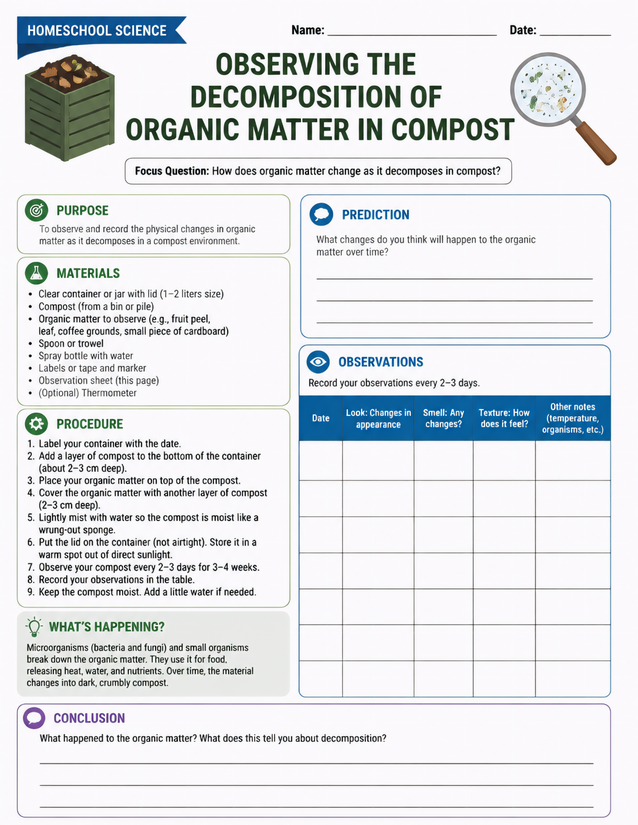
Your grades 4-7 homeschooler records physical changes using this decomposition of organic matter in compost observation sheet over three to four weeks.
Investigating Decomposition of Organic Matter in Compost

Usage Notes
Nearly every material on the list is a household item: a jar with a lid, compost from an existing bin or pile, organic scraps, a spray bottle, labels, and a spoon or trowel. A thermometer is listed as optional but adds depth for older students tracking heat generated by microbial activity. Keep the container away from direct sunlight and remind your student to wear gloves when handling compost, especially if they are adding material on observation days.

Printing Tips
A standard 20 lb copy paper sheet works for a single-use recording, but 24 lb paper holds up better when students write across multiple observation sessions without the sheet buckling. Slip it into a plastic page protector inside a science binder so the sheet stays clean between data collection days.