Creative Minds 𖹭 Happy Hearts

Density Column Lab Sheet, Six Liquids from Honey to Lamp Oil
Six liquids, one cylinder, and density does all the work. This density column lab sheet walks your student from honey at the bottom to lamp oil at the top, one careful pour at a time.
Students build a six-layer density column using honey, dish soap, water, cooking oil, rubbing alcohol, and lamp oil or mineral oil, recording each liquid’s position, color used, and what its placement reveals about its density. The results table has six numbered rows labeled bottom to top, making it easy for grades 4 through 7 homeschoolers to spot the pattern as the column settles. Four reflection questions push students past observation into explanation, asking which liquid was densest, which was least dense, how density drove the order, and what would happen if the layers were mixed.
This density column lab sheet fits naturally into a physical science or chemistry unit on matter and properties, and it works equally well as a standalone experiment or as part of a broader sequence on liquid behavior. Completing it asks students to connect a visual result to a scientific principle, demonstrating that they understand density as a measurable, comparable property rather than an abstract definition.
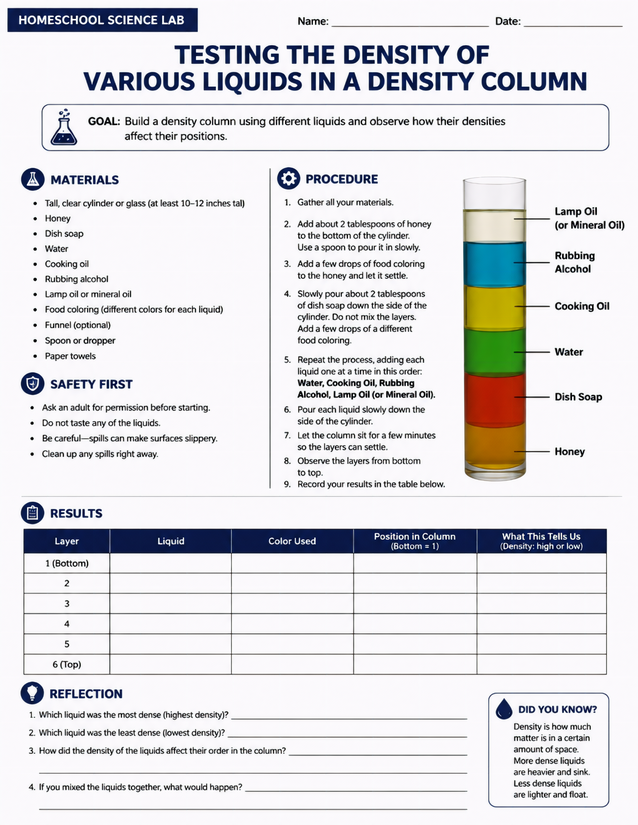
Stack six household liquids and watch density decide their order. This density column lab sheet suits grades 4 through 7 homeschoolers.
Setting Up Your Density Column Lab Sheet Step by Step

Usage Notes
Every liquid on the materials list is a household item: honey, dish soap, water, cooking oil, rubbing alcohol, and lamp oil or mineral oil. Food coloring is optional but strongly recommended so the layers are visually distinct in the results table. The safety section on the sheet flags that rubbing alcohol and cooking oil can make surfaces slippery, so a tray or newspaper under the cylinder is worth setting out before you start.
Printing Tips
Cardstock is not ideal here since students write through a full results table and four reflection questions during the experiment. A 24-pound copy sheet on a clipboard keeps the page flat and wrinkle-free if any liquid splashes nearby. Skip laminating for this one, the writing sections are too detailed for a wipe-and-reuse approach.